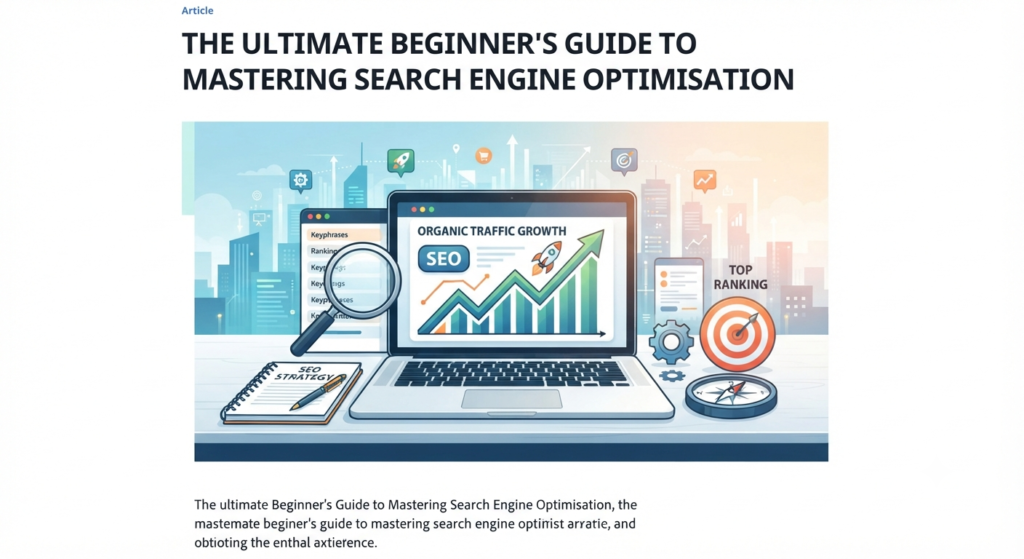


Search Engine Optimisation is one of the most valuable digital marketing skills for businesses, marketers, bloggers, and website owners who want to increase their online visibility without relying entirely on paid advertising. Every day, millions of people use search engines to find products, services, answers, and solutions. If your website appears near the top of relevant search results, you have a greater opportunity to attract qualified visitors who are already interested in what you offer.
Unlike paid advertising, where traffic usually stops when the advertising budget ends, Search Engine Optimisation focuses on improving a website’s visibility through high-quality content, technical improvements, and a positive user experience. Although SEO requires patience and continuous effort, it can become one of the most sustainable sources of long-term organic traffic.
Whether you manage a business website, an e-commerce store, a personal blog, or a corporate portal, understanding Search Engine Optimisation helps you build authority, increase brand awareness, generate qualified leads, and improve conversions. Modern SEO is no longer about repeating keywords or manipulating search engines. Instead, it emphasizes creating valuable content that satisfies user intent while making websites fast, accessible, and easy to navigate.
This comprehensive guide explains how Search Engine Optimisation works, why it matters, its core components, best practices, common mistakes, and practical strategies you can implement to improve your website’s search performance. By following these recommendations consistently, you’ll build a stronger online presence that supports long-term business growth.
Quick Answer
Search Engine Optimisation is the process of improving a website’s visibility in organic search engine results by optimizing content, website structure, technical performance, user experience, and authority. The goal is to attract relevant visitors, improve search rankings, and generate sustainable traffic without depending solely on paid advertisements.
Why Search Engine Optimisation Matters
People often begin their online journey with a search engine when looking for information, products, or services. Appearing in relevant search results allows businesses to connect with users who already have a specific need or intent.
A strong Search Engine Optimisation strategy helps businesses:
- Increase organic website traffic
- Improve online visibility
- Build brand credibility
- Generate qualified leads
- Improve user experience
- Reduce dependence on paid advertising
- Support long-term digital growth
- Increase conversion opportunities
Instead of interrupting users with advertisements, SEO helps your website become discoverable when users actively search for relevant information.
What Is Search Engine Optimisation?
Search Engine Optimisation (SEO) is the practice of improving various aspects of a website so that search engines can better understand, index, and rank its content.
A complete Search Engine Optimisation strategy typically includes:
- Keyword research
- High-quality content creation
- On-page optimization
- Technical SEO
- Internal linking
- Website performance optimization
- Mobile usability
- Link building
- User experience improvements
- Performance monitoring
The objective is not simply to rank higher but to provide the most relevant and helpful content for users.
How Search Engine Optimisation Works
Search engines evaluate websites through several stages before displaying results.
Website Creation
↓
Crawling
↓
Indexing
↓
Content Evaluation
↓
Ranking
↓
Search Results
↓
User Interaction
↓
Continuous Optimization
Understanding this process helps website owners make improvements that benefit both users and search engines.
Why Search Engine Optimisation Matters
People often begin their online journey with a search engine when looking for information, products, or services. Appearing in relevant search results allows businesses to connect with users who already have a specific need or intent.
A strong Search Engine Optimisation strategy helps businesses:
- Increase organic website traffic
- Improve online visibility
- Build brand credibility
- Generate qualified leads
- Improve user experience
- Reduce dependence on paid advertising
- Support long-term digital growth
- Increase conversion opportunities
Instead of interrupting users with advertisements, SEO helps your website become discoverable when users actively search for relevant information.
How to Conduct Effective Keyword Research
You cannot write content blindly and expect search engines to reward your efforts. You must find out what specific phrases your target audience types into search bars. This process starts with thorough keyword research to uncover high-intent search terms.
Start by brainstorming broad topics related to your core niche and business goals. Next, use professional platforms to check the monthly search volume and competition level for each phrase. Targeting specific long-tail phrases usually offers a much higher conversion rate for new websites.
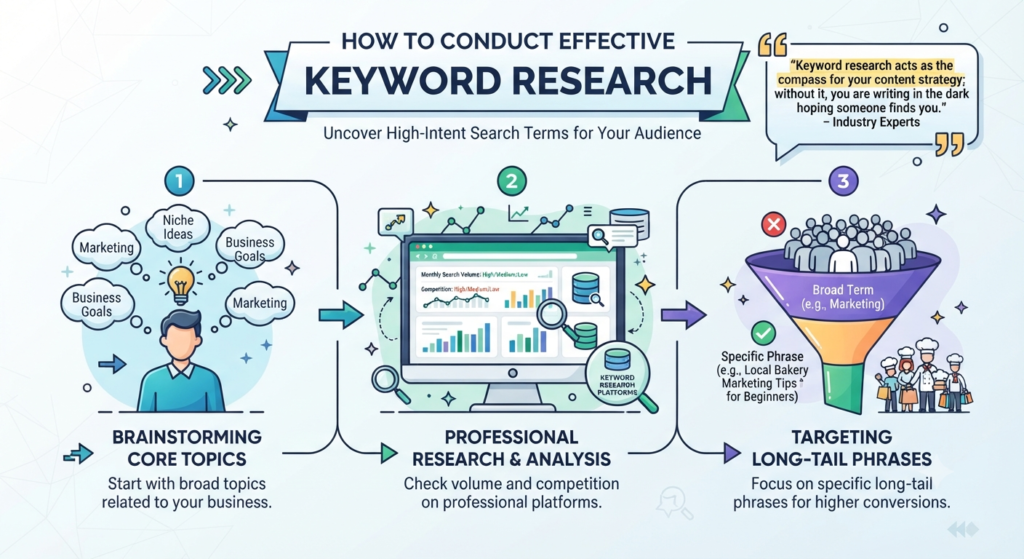
“Keyword research acts as the compass for your content strategy; without it, you are writing in the dark hoping someone finds you.” [Quote by Industry Experts]
For example, instead of targeting a broad term like marketing, a new blog should target a specific phrase like local bakery marketing tips for beginners. This targeted approach reduces competition and attracts the exact audience looking for your solutions.
Mastering On-page SEO Techniques
Once you select your target terms, you need to integrate them properly into your web pages. On-page SEO involves optimizing elements directly on your site so search engines can read them clearly. This includes your title tags, meta descriptions, subheadings, and body paragraphs.
Your main keyword should appear naturally in your title tag and within the first hundred words of your introduction. Make sure you do not stuff your target phrase unnaturally into every single sentence. Search engines penalize keyword stuffing, and human readers will bounce away immediately if the text sounds robotic.
| Optimization Element | Best Practice | Common Mistake |
| Title Tag | Keep under 60 characters with the main keyword near the front. | Stuffing multiple keywords or making it too long. |
| Meta Description | Write a compelling 150-character summary with a clear call-to-action. | Leaving it blank or writing irrelevant descriptions. |
| Headings | Use a clear H1, H2, and H3 hierarchy for readability. | Using random heading sizes just for visual styling. |
Essential SEO Tools to Track Your Progress
You cannot improve what you do not measure accurately over time. Using the right platforms helps you monitor your keyword rankings and spot technical errors on your site. SEO tools and free solutions give you deep insights into how users find your pages. Google Search Console is an absolute must-have platform for any website owner. It shows you the exact queries people use to find your site and highlights any crawling errors.
Step-by-Step Implementation Strategy
Implementing these strategies requires a repeatable framework that you can follow every time you publish content. Here is a simple step-by-step breakdown to guide your daily workflow:
- Identify Your Topic: Pick a specific problem your audience faces that has proven search demand.
- Find Your Search Terms: Select one primary target phrase and a few supporting terms.
- Draft Your Content: Write a comprehensive guide using short paragraphs and clear headings.
- Optimize Your Elements: Insert your keywords naturally into the title, subheadings, and opening paragraphs.
- Publish and Monitor: Launch your page and track its performance in your analytics dashboard after a few weeks.
Real-world execution proves that consistency beats perfection every single time. For example, a small lifestyle blog increased its monthly traffic significantly in six months by strictly following this exact five-step optimization checklist.

Core Components of Search Engine Optimisation
Every effective Search Engine Optimisation strategy combines multiple areas of optimization.
| Component | Purpose |
|---|---|
| Keyword Research | Identify relevant search queries |
| On-Page SEO | Optimize individual pages |
| Technical SEO | Improve website performance |
| Content Strategy | Provide valuable information |
| Internal Linking | Improve navigation and authority |
| Off-Page SEO | Build website credibility |
| Analytics | Measure SEO performance |
| Continuous Optimization | Maintain long-term growth |
These components work together to improve both search visibility and user experience.
Benefits of Search Engine Optimisation
A well-planned Search Engine Optimisation strategy offers long-term advantages.
Increase Organic Traffic
SEO helps your website attract visitors from unpaid search results, creating a sustainable source of qualified traffic.
Improve Brand Authority
Websites that consistently publish helpful, reliable content often become trusted resources within their industries.
Better User Experience
SEO encourages improvements in website speed, navigation, readability, and mobile usability, benefiting both users and search engines.
Higher Quality Leads
Visitors arriving through relevant search queries often have stronger intent, making them more likely to convert into customers.
Cost-Effective Marketing
Although SEO requires time and effort, it can continue generating traffic long after content is published, making it a valuable long-term marketing investment.
Types of Search Engine Optimisation
SEO includes several specialized areas that work together.
On-Page SEO
Focuses on optimizing individual web pages.
Examples include:
- Title tags
- Meta descriptions
- Headings
- Keyword placement
- Internal links
- Image optimization
- Content quality
Technical SEO
Ensures search engines can efficiently crawl and index your website.
Common areas include:
- Website speed
- Mobile responsiveness
- XML sitemap
- Robots.txt
- HTTPS
- Structured data
- Core Web Vitals
Off-Page SEO
Focuses on improving website authority through external signals.
Examples include:
- Quality backlinks
- Brand mentions
- Digital PR
- Guest posting
- Industry citations
Local SEO
Helps businesses appear in local search results.
Important factors include:
- Business profile optimization
- Local citations
- Customer reviews
- Location pages
- Local keywords
Each type contributes to an effective Search Engine Optimisation strategy.
Step 1: Understand Search Intent
Search intent is the reason behind a user’s search query.
The four primary intent types are:
Informational
Users want to learn something.
Example:
“How does SEO work?”
Navigational
Users want to visit a specific website.
Example:
“Google Search Console”
Commercial Investigation
Users compare products or services before making a decision.
Example:
“Best SEO tools”
Transactional
Users are ready to take action.
Example:
“Buy SEO software”
Creating content that matches user intent is one of the most important principles of modern Search Engine Optimisation.
Step 2: Perform Keyword Research
Keyword research helps identify the words and phrases your audience uses when searching online.
Consider:
- Primary keywords
- Long-tail keywords
- Question-based keywords
- Semantic keywords
- Search intent
- Competition level
Rather than targeting only high-volume keywords, focus on search terms that align with your audience’s needs and business objectives.
Step 3: Create High-Quality Content
Content remains the foundation of successful Search Engine Optimisation.
Effective content should:
- Answer user questions
- Be accurate
- Be easy to read
- Include practical examples
- Stay organized
- Provide unique value
- Match search intent
- Be updated regularly
Publishing content that genuinely helps users increases the likelihood of earning visibility and trust.
Step 4: Optimize On-Page SEO
Every page should be optimized for both readers and search engines.
Important elements include:
- SEO title
- Meta description
- URL structure
- H1 heading
- H2 and H3 headings
- Image ALT text
- Internal links
- External references
- Readable formatting
On-page optimization improves content clarity while helping search engines understand page topics.
Step 5: Improve Technical SEO
Technical improvements ensure search engines can efficiently access your website.
Focus on:
- Fast page loading
- Mobile-friendly design
- Secure HTTPS connection
- Clean site architecture
- Crawlability
- XML sitemap
- Robots.txt configuration
- Structured data where appropriate
A technically healthy website supports stronger Search Engine Optimisation performance.
Step 6: Build an Internal Linking Strategy
Internal links help users discover related content while improving website organization.
Best practices include:
- Link to relevant articles
- Use descriptive anchor text
- Connect topic clusters
- Avoid excessive linking
- Update older content with new links
A thoughtful internal linking structure improves navigation and distributes authority throughout your website.
Step 7: Optimize Images
Images improve user experience but should also support SEO.
Optimize images by:
- Compressing file sizes
- Using descriptive file names
- Adding keyword-relevant ALT text
- Choosing appropriate formats
- Maintaining responsive image sizing
Well-optimized images can contribute to better page performance and additional visibility through image search.
Step 8: Build High-Quality Backlinks
Backlinks are links from other websites pointing to your pages. Search engines generally consider quality backlinks as signals that your content is valuable and trustworthy. However, not all backlinks have the same value. A few relevant links from authoritative websites are often more beneficial than many low-quality links.
Effective ways to earn backlinks include:
- Publish original, in-depth content
- Create useful guides and resources
- Produce shareable infographics
- Build relationships with industry websites
- Write guest articles for reputable publications
- Conduct original research where appropriate
- Update outdated content with better information
Focus on earning backlinks naturally instead of buying or exchanging links, as manipulative link-building practices may violate search engine guidelines and negatively affect your Search Engine Optimisation efforts.
Step 9: Improve Core Web Vitals
Core Web Vitals measure important aspects of user experience, including loading performance, visual stability, and responsiveness. A faster, smoother website keeps visitors engaged and supports better Search Engine Optimisation.
Improve Core Web Vitals by:
- Optimizing images
- Reducing unnecessary JavaScript
- Using browser caching
- Improving server response times
- Loading critical resources first
- Minimizing layout shifts
- Using a reliable hosting provider
A fast website not only improves rankings but also increases user satisfaction and conversion opportunities.
Step 10: Use SEO Analytics and Monitoring Tools
Tracking performance helps you understand whether your Search Engine Optimisation strategy is working.
Monitor important metrics such as:
| Metric | Why It Matters |
|---|---|
| Organic Traffic | Measures visitors from search engines |
| Keyword Rankings | Shows search visibility |
| Click-Through Rate (CTR) | Indicates title and meta description effectiveness |
| Bounce Rate | Helps evaluate user engagement |
| Average Session Duration | Measures content usefulness |
| Indexed Pages | Confirms search engine indexing |
| Backlinks | Tracks website authority |
| Conversion Rate | Measures business impact |
Review performance regularly and make improvements based on real data instead of assumptions.
Step 11: Optimize for Mobile SEO
Most users now browse websites on mobile devices. A poor mobile experience can reduce engagement and negatively impact Search Engine Optimisation.
Ensure your website provides:
- Responsive design
- Fast loading speed
- Easy navigation
- Readable text
- Proper button spacing
- Mobile-friendly forms
- Optimized images
A mobile-first approach benefits both users and search engine visibility.
Step 12: Create a Strong Content Strategy
Publishing random articles rarely produces sustainable SEO results. Instead, build a content strategy around your audience’s needs.
A successful content strategy should include:
- Keyword research
- Topic clusters
- Editorial calendar
- Evergreen content
- Regular updates
- Internal linking
- Performance reviews
A structured publishing plan strengthens your Search Engine Optimisation while building topical authority over time.
Step 13: Focus on E-E-A-T Principles
Modern search engines prioritize content that demonstrates Experience, Expertise, Authoritativeness, and Trustworthiness (E-E-A-T).
Strengthen E-E-A-T by:
- Publishing accurate information
- Updating content regularly
- Citing reliable sources where appropriate
- Displaying author information
- Maintaining transparent contact details
- Providing helpful and original insights
Trustworthy content benefits both readers and search engine performance.
Step 14: Refresh Existing Content
SEO is not limited to publishing new articles. Updating older pages can improve rankings and keep information relevant.
Consider updating:
- Outdated statistics
- Broken links
- Screenshots
- Internal links
- Examples
- FAQs
- Keywords
- Formatting
Refreshing valuable content often produces better results than continually creating new pages without maintaining existing ones.
Step 15: Continuously Improve Your SEO Strategy
Search algorithms, user expectations, and competition change regularly. Continuous improvement helps maintain strong Search Engine Optimisation performance.
Review your strategy by:
- Monitoring rankings
- Updating content
- Improving page speed
- Expanding topic coverage
- Reviewing competitor trends
- Testing page improvements
- Tracking conversions
SEO is an ongoing process rather than a one-time project.
Search Engine Optimisation Framework
Follow this repeatable workflow:
Research
Understand your audience, competitors, and search intent.
Plan
Perform keyword research and organize content into topic clusters.
Create
Publish high-quality content that solves user problems.
Optimize
Improve on-page SEO, technical SEO, and internal linking.
Promote
Earn backlinks and increase content visibility.
Measure
Track rankings, traffic, engagement, and conversions.
Improve
Update content and optimize continuously based on performance.
Using this structured workflow helps create a sustainable Search Engine Optimisation strategy.
On-Page SEO vs Technical SEO vs Off-Page SEO
| On-Page SEO | Technical SEO | Off-Page SEO |
|---|---|---|
| Optimizes page content | Improves website infrastructure | Builds website authority |
| Focuses on keywords | Focuses on crawlability | Focuses on backlinks |
| Improves readability | Improves speed | Improves trust |
| Uses internal links | Enhances mobile usability | Earns external mentions |
| Optimizes headings | Supports indexing | Increases credibility |
A balanced strategy combines all three areas for the best long-term results.
Recommended SEO Tools
The right tools simplify keyword research, technical audits, and performance tracking.
| Tool Type | Purpose |
|---|---|
| Keyword Research | Discover relevant search terms |
| Website Audit | Identify technical issues |
| Rank Tracking | Monitor keyword positions |
| Analytics | Measure traffic and user behavior |
| Search Performance | Monitor impressions and clicks |
| Page Speed Testing | Improve website performance |
| Content Optimization | Enhance content quality |
Select tools that align with your goals and workflow rather than using every available platform.
30-Day Search Engine Optimisation Action Plan
Week 1
- Audit your website
- Research keywords
- Identify search intent
- Analyze competitors
Week 2
- Optimize existing pages
- Improve technical SEO
- Create internal links
- Compress images
Week 3
- Publish high-quality content
- Optimize title tags
- Improve meta descriptions
- Build topic clusters
Week 4
- Review analytics
- Track keyword rankings
- Update older articles
- Plan next month’s content
Following a structured roadmap helps you improve SEO consistently instead of making isolated changes.
Common Mistakes to Avoid
Avoiding typical beginner errors saves you months of wasted effort. Watch out for these common traps:
- Keyword Stuffing: Overusing your target phrase in a way that sounds unnatural to human readers.
- Ignoring Mobile Users: Failing to check how your layout looks on smaller smartphone screens.
- Skipping Meta Tags: Leaving title tags and descriptions blank or unoptimized.
- Publishing Thin Content: Writing short articles that do not fully answer the user query.
- Neglecting Site Speed: Using heavy uncompressed images that slow down page loading times.
Pro Tips for Better Rankings
Implement these professional recommendations to take your optimization efforts to the next level:
- Update your older articles regularly with fresh facts and updated examples.
- Use descriptive alt text for every image to capture extra visual search traffic.
- Structure your content with clear headings so readers can scan easily.
Frequently Asked Questions
How long does it take to see results from Search Engine Optimization (SEO)?
Most new websites take anywhere from three to six months to start ranking consistently for competitive search terms. Search engines need time to crawl, index, and trust your content.
Do I need to pay for professional software to rank my website?
No, you do not need expensive platforms when starting out. Free solutions like Google Search Console and basic keyword planners provide more than enough data for beginners.
How often should I update my published articles?
You should review your top-performing content every six months to ensure the facts, statistics, and links remain accurate and up-to-date.
Is keyword density still important for modern rankings?
Exact keyword density matters much less today than natural context and user intent. Focus on writing helpful content that thoroughly answers the user’s query rather than counting your keyword mentions.
Conclusion
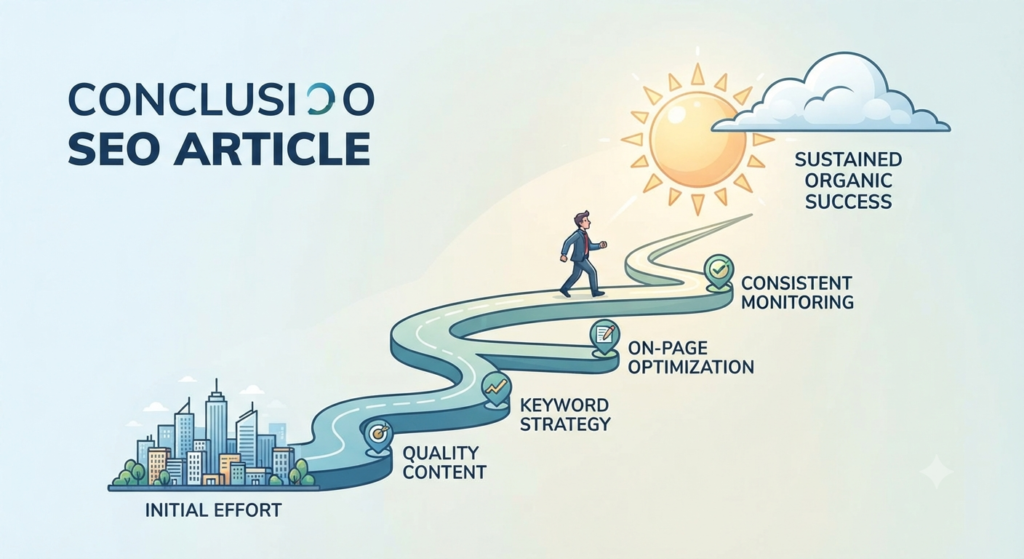
An effective Search Engine Optimisation strategy goes far beyond ranking for a few keywords. It combines high-quality content, technical excellence, user-focused design, strategic keyword research, internal linking, and continuous optimization to create a website that both users and search engines trust. Businesses that prioritize helpful content and a positive user experience are more likely to achieve sustainable organic growth over time.
One of the greatest strengths of Search Engine Optimisation is its ability to generate long-term value. Unlike marketing channels that depend entirely on advertising budgets, SEO can continue driving qualified traffic long after content is published and optimized. By consistently updating your website, monitoring performance, and adapting to evolving search trends, you can strengthen your online presence and remain competitive in changing markets.
Remember that SEO is a continuous journey rather than a one-time project. Regularly review analytics, improve existing pages, expand your topical authority, and refine your strategy based on real user behavior. Small, consistent improvements often lead to meaningful long-term results.
Businesses and website owners who invest in Search Engine Optimisation with patience, consistency, and a user-first mindset are better positioned to increase organic traffic, generate qualified leads, build lasting brand authority, and achieve sustainable digital success.