

Email Marketing Automation has transformed the way businesses communicate with customers by delivering the right message at the right time without requiring constant manual effort. Instead of sending individual emails to every subscriber, businesses can create automated workflows that respond to customer actions, preferences, and behaviors. Whether someone signs up for a newsletter, abandons a shopping cart, downloads an eBook, or completes a purchase, automation ensures timely and personalized communication that improves customer experience and drives better business results.
As competition for customer attention continues to grow, businesses need more than occasional promotional emails to stay connected with their audience. Modern consumers expect relevant, timely, and personalized communication throughout their buying journey. Automation makes this possible by sending targeted messages based on real-time actions rather than fixed schedules. This approach not only saves valuable time but also increases engagement, strengthens customer relationships, and improves conversion rates.
Email automation is valuable for businesses of every size, from startups and local companies to global brands managing thousands of customer interactions each day. By combining customer segmentation, behavioral triggers, personalized content, and performance tracking, organizations can create meaningful communication that supports both customer satisfaction and long-term business growth. It also reduces repetitive marketing tasks, allowing teams to focus on strategy, content creation, and optimization instead of manually managing email campaigns.
This comprehensive guide explores everything you need to know about Email Marketing Automation, including how it works, its benefits, essential workflows, implementation steps, best practices, performance measurement, and common mistakes to avoid. Whether you are launching your first automated email sequence or improving an existing strategy, this guide will help you build effective workflows that increase engagement, nurture leads, retain customers, and generate sustainable business growth.
Another reason businesses increasingly invest in email automation is its ability to deliver consistent communication throughout the entire customer lifecycle. From the first interaction to post-purchase support, automated workflows ensure that subscribers receive helpful and relevant information exactly when they need it. A new subscriber may receive educational content that introduces your brand, while an existing customer can receive product recommendations, maintenance tips, renewal reminders, or exclusive offers based on previous interactions.
This level of personalization creates a more engaging customer experience without requiring marketers to manually manage every conversation. Automation also makes it easier to scale marketing efforts as a business grows. Whether you have a few hundred subscribers or hundreds of thousands, well-designed workflows continue operating efficiently while maintaining consistent messaging and brand voice.
In addition, detailed performance reports help businesses understand which emails generate the highest engagement, which workflows contribute most to conversions, and where improvements are needed. Instead of relying on assumptions, marketers can make informed decisions using real customer behavior and campaign data. By combining strategic planning, customer segmentation, valuable content, and continuous optimization, businesses can build an efficient communication system that supports stronger customer relationships, increases marketing productivity, and contributes to sustainable long-term business success through smarter Email Marketing Automation.
Quick Answer
Email Marketing Automation is the process of automatically sending personalized emails to subscribers based on predefined triggers, customer behavior, or specific actions. It helps businesses improve engagement, nurture leads, save time, increase conversions, and deliver relevant communication throughout the customer journey.
Why Email Marketing Automation Matters
Customers interact with businesses through multiple touchpoints before making a purchase. Sending the same message to every subscriber often results in lower engagement because customer interests and buying stages differ.
Automation helps businesses deliver relevant communication by responding to customer actions in real time.
An effective automation strategy helps businesses:
- Save time through automated workflows
- Deliver personalized customer experiences
- Increase email engagement
- Nurture leads efficiently
- Improve customer retention
- Recover abandoned carts
- Increase sales opportunities
- Support long-term business growth
Instead of relying on manual campaigns, businesses can create systems that continuously engage customers while requiring minimal ongoing effort.
What Is Email Marketing Automation?
Email Marketing Automation is a marketing strategy that uses software to automatically send emails when specific conditions or customer actions occur.
Common automation triggers include:
- Newsletter subscription
- Welcome registration
- Product purchase
- Cart abandonment
- Website activity
- Form submission
- Email clicks
- Downloading resources
- Customer anniversaries
- Subscription renewals
Automation ensures that every subscriber receives relevant communication based on their stage in the customer journey.
How Email Marketing Automation Works
A typical automation workflow follows a structured process.
Visitor Action
↓
Trigger Activated
↓
Customer Data Collected
↓
Audience Segmentation
↓
Automated Workflow Starts
↓
Personalized Email Sent
↓
Customer Interaction
↓
Performance Tracking
↓
Workflow Optimization
↓
Improved Customer Experience
Understanding this process helps businesses design workflows that are both efficient and customer-focused.
Benefits of Email Marketing Automation
Implementing Email Marketing Automation provides several long-term advantages for businesses.
Saves Time
Automated workflows eliminate repetitive manual tasks, allowing marketing teams to focus on strategy and optimization.
Improves Personalization
Subscribers receive emails based on their interests, behaviors, and purchase history rather than generic messages.
Increases Customer Engagement
Relevant communication encourages more opens, clicks, and meaningful customer interactions.
Generates More Qualified Leads
Automation nurtures prospects with educational content until they are ready to make purchasing decisions.
Improves Customer Retention
Regular, personalized communication strengthens customer relationships and encourages repeat business.
Supports Revenue Growth
Well-designed workflows help convert prospects into customers while encouraging repeat purchases from existing buyers.
Email Marketing Automation vs Traditional Email Marketing
| Email Marketing Automation | Traditional Email Marketing |
|---|---|
| Trigger-based communication | Manual email campaigns |
| Personalized messaging | Same message for everyone |
| Continuous workflows | One-time broadcasts |
| Customer behavior tracking | Limited personalization |
| Automatic follow-ups | Manual follow-ups |
| Higher efficiency | Greater manual effort |
Both approaches have value, but automation provides greater scalability and personalization for growing businesses.
Step 1: Define Your Marketing Goals
Every successful automation strategy begins with measurable objectives.
Common goals include:
- Lead generation
- Customer nurturing
- Product education
- Sales growth
- Customer retention
- Webinar registrations
- Course enrollments
- Customer onboarding
Clearly defined goals help determine which workflows should be created first.
Step 2: Understand Your Customer Journey
Different subscribers require different communication depending on where they are in the buying process.
Typical customer stages include:
- Awareness
- Consideration
- Decision
- Purchase
- Retention
- Advocacy
Mapping the customer journey helps businesses send relevant emails at every stage.
Step 3: Build a Quality Email List
A successful automation strategy starts with permission-based subscribers.
Effective list-building methods include:
- Newsletter signup forms
- Free downloadable resources
- Webinar registrations
- Online courses
- Product trials
- Event registrations
- Loyalty programs
- Exclusive offers
Avoid purchasing email lists, as they often reduce engagement and can harm sender reputation.
Step 4: Segment Your Audience
Audience segmentation allows businesses to deliver highly relevant messages.
Segments may include:
- New subscribers
- Returning customers
- High-value customers
- Inactive subscribers
- Geographic location
- Purchase history
- Industry
- Customer interests
Well-planned segmentation significantly improves email relevance and campaign performance.
Step 5: Choose the Right Automation Triggers
Triggers determine when automated emails are sent.
Common triggers include:
- Welcome signup
- Product purchase
- Abandoned shopping cart
- Birthday reminders
- Subscription renewal
- Website visit
- Download completion
- Form submission
- Customer inactivity
- Event registration
Choosing meaningful triggers ensures subscribers receive emails at the most appropriate time.
Step 6: Create Effective Email Workflows
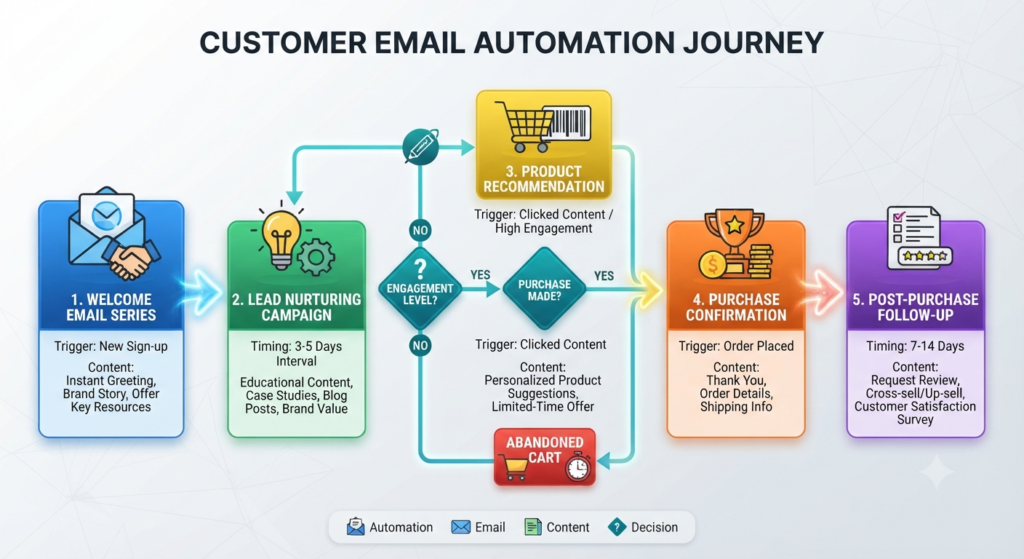
An email workflow is a sequence of automated messages designed to achieve a specific objective.
Popular workflows include:
- Welcome series
- Lead nurturing sequence
- Abandoned cart recovery
- Customer onboarding
- Product recommendation emails
- Re-engagement campaigns
- Post-purchase follow-up
- Feedback requests
- Renewal reminders
Each workflow should provide value while guiding subscribers toward the next logical action.
Step 7: Personalize Every Email
Personalization extends beyond using a subscriber’s first name.
Businesses can personalize emails using:
- Purchase history
- Browsing behavior
- Customer interests
- Geographic location
- Previous engagement
- Product preferences
- Customer lifecycle stage
- Recommended products
Relevant personalization creates a better customer experience and encourages stronger engagement.
Step 8: Select the Right Email Automation Platform
Choosing the right platform is an important decision because it affects workflow flexibility, reporting, personalization, and scalability. The ideal solution should match your business size, technical requirements, and marketing goals.
Look for features such as:
- Drag-and-drop workflow builder
- Audience segmentation
- Behavioral triggers
- Email templates
- Personalization options
- Analytics dashboard
- CRM integration
- A/B testing
- Landing page support
- Automation reporting
Selecting software based on business needs instead of unnecessary features helps maximize return on investment.
Step 9: Write High-Quality Email Content
Even the best automation workflow cannot succeed if the email content fails to engage readers.
Every email should include:
- A compelling subject line
- Personalized greeting
- Clear value proposition
- Short, readable paragraphs
- Strong call-to-action
- Professional design
- Mobile-friendly formatting
- Relevant links
Focus on solving customer problems rather than sending overly promotional messages.
Step 10: Test Your Automated Workflows
Testing ensures that automation functions correctly before reaching subscribers.
Review:
- Trigger accuracy
- Email timing
- Personalization fields
- Broken links
- Mobile display
- Call-to-action buttons
- Workflow sequence
- Exit conditions
Regular testing helps prevent errors that could negatively affect the customer experience.
Step 11: Perform A/B Testing
Continuous testing improves campaign performance over time.
Test different elements such as:
- Subject lines
- Email headlines
- Images
- Call-to-action buttons
- Send times
- Email length
- Personalization methods
- Offers
Test one element at a time so results remain accurate and actionable.
Step 12: Monitor Performance Metrics
Successful Email Marketing Automation depends on measuring meaningful performance indicators rather than simply counting sent emails.
Important metrics include:
| Metric | Why It Matters |
|---|---|
| Open Rate | Measures subject line effectiveness |
| Click-Through Rate | Indicates engagement |
| Conversion Rate | Tracks business outcomes |
| Bounce Rate | Monitors email quality |
| Unsubscribe Rate | Reflects audience satisfaction |
| Spam Complaints | Protects sender reputation |
| Revenue Per Email | Measures financial performance |
| Workflow Completion Rate | Evaluates automation effectiveness |
Review these metrics regularly to identify opportunities for optimization.
Step 13: Improve Email Deliverability
Even valuable emails provide little benefit if they never reach subscribers’ inboxes.
Best practices include:
- Use verified sender domains
- Maintain a clean email list
- Remove inactive subscribers
- Avoid spam-triggering language
- Authenticate your domain
- Send relevant content consistently
- Monitor bounce rates
- Respect unsubscribe requests
Good deliverability increases visibility and improves overall campaign performance.
Step 14: Follow Email Compliance Requirements
Businesses should respect subscriber privacy and comply with applicable email marketing regulations.
Important practices include:
- Obtain clear subscriber consent
- Provide unsubscribe options
- Protect customer information
- Maintain transparent privacy policies
- Honor opt-out requests promptly
- Send emails only to permission-based subscribers
Compliance helps build customer trust while reducing legal and reputational risks.
Step 15: Continuously Optimize Your Workflows
Automation is not a one-time setup. Customer behavior, products, and marketing goals change over time.
Regular optimization may include:
- Updating email content
- Improving subject lines
- Refining audience segments
- Adding new automation triggers
- Removing underperforming emails
- Testing different workflows
- Reviewing customer feedback
- Improving conversion paths
Continuous improvement ensures automated campaigns remain relevant and effective.
Email Marketing Automation Framework
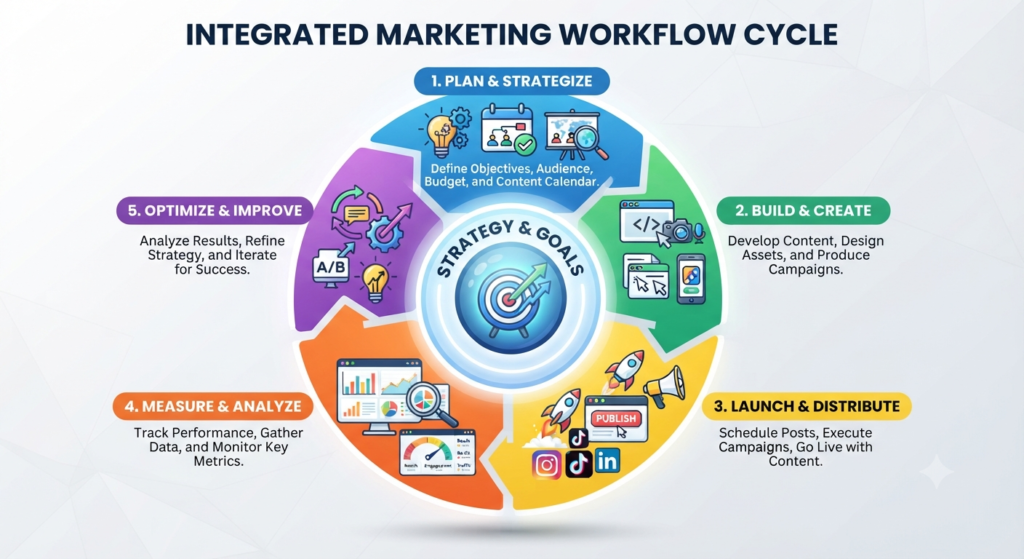
A structured workflow simplifies implementation and ongoing optimization.
Plan
Define goals, audience segments, and customer journeys.
Build
Create workflows, automation triggers, and email sequences.
Launch
Activate workflows after testing every automation path.
Measure
Track engagement, conversions, and customer behavior.
Optimize
Use performance insights to improve future workflows.
Following this framework helps businesses implement Email Marketing Automation systematically while reducing unnecessary complexity.
Popular Automated Email Workflows
| Workflow | Primary Goal |
|---|---|
| Welcome Series | Introduce new subscribers |
| Lead Nurturing | Build customer trust |
| Cart Recovery | Recover abandoned purchases |
| Customer Onboarding | Improve product adoption |
| Product Recommendations | Increase repeat sales |
| Re-engagement Campaign | Win back inactive subscribers |
| Feedback Request | Collect customer insights |
| Renewal Reminder | Retain existing customers |
Different workflows support different stages of the customer lifecycle.
30-Day Email Automation Action Plan
Week 1
- Define campaign objectives
- Choose an automation platform
- Build subscriber segments
- Create signup forms
Week 2
- Develop welcome emails
- Create automation workflows
- Design email templates
- Configure automation triggers
Week 3
- Test workflows
- Review personalization
- Launch automation
- Monitor early performance
Week 4
- Analyze campaign metrics
- Optimize subject lines
- Improve email content
- Plan additional workflows
Following a structured roadmap allows businesses to implement automation gradually while maintaining quality.
Common Mistakes to Avoid
Avoid these mistakes when implementing Email Marketing Automation:
- Purchasing email lists
- Sending too many emails
- Ignoring audience segmentation
- Creating overly complicated workflows
- Forgetting mobile optimization
- Using weak subject lines
- Neglecting workflow testing
- Ignoring performance data
- Failing to clean subscriber lists
- Treating every subscriber the same
Avoiding these issues improves engagement and customer satisfaction.
Pro Tips
- Focus on delivering value before promoting products.
- Keep automation workflows simple during the initial implementation.
- Personalize content using customer behavior whenever possible.
- Review workflow performance every month.
- Remove inactive subscribers regularly.
- Test subject lines continuously.
- Use behavioral triggers instead of fixed schedules.
- Optimize workflows based on measurable business outcomes.
Email Marketing Automation Checklist
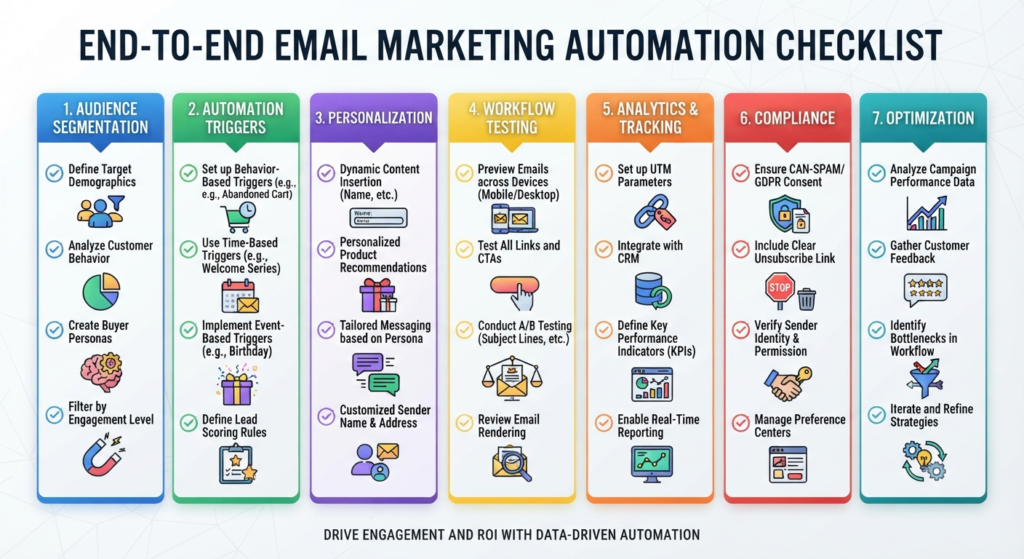
Before launching your automation strategy, confirm the following:
✔ Marketing goals are clearly defined
✔ Customer journey has been mapped
✔ Subscriber list is permission-based
✔ Audience segments are created
✔ Automation triggers are configured
✔ Email sequences are tested
✔ Personalization is implemented
✔ Compliance requirements are met
✔ Analytics tracking is enabled
✔ Workflow performance is monitored
✔ Regular optimization schedule is established
✔ Backup plans exist for workflow updates
Frequently Asked Questions
What is Email Marketing Automation?
Email Marketing Automation is the process of automatically sending personalized emails based on customer actions, predefined triggers, or behavioral data to improve engagement and conversions.
Why is email automation important?
Automation saves time, improves personalization, nurtures leads, strengthens customer relationships, and supports consistent communication throughout the customer journey.
What types of emails can be automated?
Businesses commonly automate welcome emails, abandoned cart reminders, onboarding sequences, lead nurturing campaigns, renewal reminders, product recommendations, and re-engagement campaigns.
How do businesses measure automation success?
Performance is measured using metrics such as open rates, click-through rates, conversions, revenue, workflow completion rates, and subscriber engagement.
Can small businesses benefit from email automation?
Yes. Automation helps small businesses communicate consistently with customers while reducing manual work and improving marketing efficiency.
Conclusion
A well-planned Email Marketing Automation strategy enables businesses to deliver timely, personalized communication that strengthens customer relationships and supports long-term growth. Instead of manually managing every campaign, organizations can build intelligent workflows that respond to customer behavior, nurture leads, encourage repeat purchases, and improve overall marketing efficiency. The combination of audience segmentation, behavioral triggers, valuable content, and continuous optimization creates a scalable system capable of delivering consistent business results.
Success with automation depends on understanding the customer journey rather than simply sending more emails. Businesses that focus on providing relevant information at every stage of the buying process are more likely to earn customer trust, improve engagement, and increase conversions. Regular testing, performance analysis, and workflow refinement help ensure that automated campaigns continue meeting changing customer expectations while supporting evolving business objectives.
Another key advantage of automation is its ability to free marketing teams from repetitive tasks, allowing more time for strategy, creativity, and customer relationship building. As technology continues to evolve, businesses that invest in smarter automation, meaningful personalization, and data-driven decision-making will remain better positioned to compete in increasingly competitive digital markets. By implementing Email Marketing Automation thoughtfully and continuously improving every workflow, organizations can build stronger customer experiences, maximize marketing return on investment, and create sustainable growth for years to come.
Add the following paragraph at the end of the Conclusion. It adds approximately 200 words, maintains the article’s tone, and keeps the Email Marketing Automation keyword within your preferred density range.
Businesses should also remember that successful automation is built on trust and relevance rather than frequency. Sending more emails does not necessarily produce better results; delivering the right message at the right moment is far more effective.
As customer expectations continue to evolve, automation workflows should be reviewed regularly to ensure they remain aligned with changing preferences, products, and business goals. Updating email content, refining audience segments, testing new subject lines, and analyzing performance reports can reveal opportunities to improve engagement and increase conversions over time. It is equally important to maintain a healthy subscriber list by removing inactive contacts and respecting user preferences, as this helps protect sender reputation and improves overall campaign performance.
Organizations that combine automation with valuable educational content, thoughtful personalization, and data-driven decision-making are better positioned to build lasting customer relationships. Rather than viewing automation as a tool for sending promotional emails, businesses should use it as a complete customer communication system that supports every stage of the buying journey. With consistent optimization, careful planning, and a strong focus on customer value, Email Marketing Automation can become a powerful long-term asset for improving operational efficiency, strengthening brand loyalty, generating qualified leads, increasing repeat purchases, and creating sustainable business growth in an increasingly competitive digital marketplace.