

A Content Marketing Strategy is the foundation of successful digital marketing. Instead of creating random blog posts, videos, or social media content, a well-planned strategy ensures every piece of content serves a purpose, reaches the right audience, and contributes to your business goals. Whether you want to increase website traffic, generate leads, build brand authority, or improve customer retention, having a clear Content Marketing Strategy is essential.
Many businesses publish content consistently but fail to see meaningful results because they lack direction. Without a structured approach, content often misses the target audience, fails to rank on search engines, or doesn’t convert visitors into customers. This guide will help you create a practical Content Marketing Strategy that delivers measurable results and supports long-term business growth.
By the end of this tutorial, you’ll understand how to research your audience, define goals, create valuable content, optimize for SEO, distribute content effectively, and measure performance using proven best practices.
Quick Answer
A Content Marketing Strategy is a documented plan that outlines how a business creates, publishes, promotes, and manages valuable content to attract, engage, and convert its target audience. It includes audience research, content planning, SEO, distribution, performance tracking, and continuous optimization.
Why a Content Marketing Strategy Matters
Creating content without a strategy often leads to inconsistent messaging, low engagement, and wasted resources. A structured Content Marketing Strategy helps ensure every piece of content supports a specific business objective and delivers value to the intended audience.
A strong strategy helps you:
- Increase organic website traffic
- Build trust and brand authority
- Generate qualified leads
- Improve customer engagement
- Support SEO efforts
- Increase conversion rates
- Create long-term marketing assets
- Reduce content production waste
Unlike paid advertising, high-quality content can continue attracting visitors for months or even years after publication.
What Is a Content Marketing Strategy?
A Content Marketing Strategy is a long-term roadmap for creating and distributing valuable content that helps achieve specific marketing and business goals. Rather than focusing only on publishing content, it defines why the content is being created, who it is for, where it will be published, and how success will be measured.
An effective strategy combines:
- Audience research
- Business objectives
- Keyword research
- Content planning
- Search Engine Optimization (SEO)
- Content distribution
- Performance measurement
- Continuous improvement
How Content Marketing Works
The content marketing process follows a continuous cycle:
Audience Research
↓
Identify Customer Problems
↓
Keyword Research
↓
Content Planning
↓
Content Creation
↓
SEO Optimization
↓
Content Publishing
↓
Promotion & Distribution
↓
Performance Analysis
↓
Content Improvement
Instead of focusing only on publishing more content, successful businesses improve each stage of this cycle to achieve better long-term results.
Core Components of a Content Marketing Strategy
Every successful Content Marketing Strategy includes several essential components working together.
| Component | Purpose |
|---|---|
| Business Goals | Define desired outcomes |
| Target Audience | Identify who the content serves |
| Keyword Research | Discover search opportunities |
| Content Calendar | Plan publishing schedule |
| SEO Optimization | Improve search visibility |
| Content Distribution | Reach a wider audience |
| Analytics | Measure performance |
| Optimization | Improve future results |
Skipping any of these components can reduce the overall effectiveness of your strategy.
Benefits of a Content Marketing Strategy
Implementing a structured Content Marketing Strategy offers advantages beyond increasing website traffic.
Better Search Engine Rankings
SEO-focused content helps search engines understand your expertise, making it easier for potential customers to discover your website.
Higher Quality Leads
Educational content attracts users actively searching for information related to your products or services, increasing the likelihood of conversions.
Increased Brand Authority
Publishing consistently helpful content positions your business as a trusted source of information within your industry.
Long-Term Marketing Value
Unlike advertisements that stop generating results when the budget ends, optimized content can continue driving traffic over time.
Improved Customer Relationships
Useful content builds trust before customers make purchasing decisions, making them more likely to choose your business.
Types of Content Used in a Content Marketing Strategy
Different formats serve different stages of the customer journey.
| Content Type | Best Use |
|---|---|
| Blog Articles | Organic traffic |
| Videos | Education & engagement |
| Infographics | Simplifying complex topics |
| Case Studies | Building trust |
| E-books | Lead generation |
| Checklists | Practical guidance |
| Email Newsletters | Customer retention |
| Webinars | Product education |
| Podcasts | Brand awareness |
| Social Media Posts | Community engagement |
A balanced Content Marketing Strategy often combines multiple formats rather than relying on a single type of content.
Step 1: Define Your Business Goals
Every Content Marketing Strategy begins with clear objectives.
Examples include:
- Increase website traffic
- Generate qualified leads
- Improve brand awareness
- Build industry authority
- Increase product sales
- Improve customer retention
- Educate existing customers
Avoid vague goals like “publish more blogs.” Instead, define measurable outcomes that can be tracked over time.
Step 2: Understand Your Target Audience
Your content should solve real problems faced by your audience.
Research areas include:
- Age
- Location
- Occupation
- Interests
- Challenges
- Buying behavior
- Frequently asked questions
- Preferred content formats
Create a Buyer Persona
Example:
Name: Sarah
Role: Small Business Owner
Primary Goal: Increase online sales
Challenges:
- Limited marketing budget
- Low website traffic
- Lack of SEO knowledge
Preferred Content:
- Step-by-step guides
- Video tutorials
- Case studies
- Practical checklists
Creating buyer personas helps ensure every content piece addresses genuine audience needs.
Step 3: Perform Keyword Research
Keyword research forms the SEO foundation of any Content Marketing Strategy.
Focus on:
Primary Keywords
Your main topic.
Example:
- Content Marketing Strategy
Secondary Keywords
Related topics.
Examples:
- Content Marketing Plan
- Content Strategy Guide
- Content Creation Strategy
- Content Marketing Tips
Long-Tail Keywords
Specific search queries with clearer intent.
Examples:
- How to create a content marketing strategy
- Content marketing strategy for small business
- Best content marketing strategy for beginners
- Content marketing strategy examples
Targeting a mix of keyword types helps attract users at different stages of the buying journey.
Step 4: Analyze Search Intent
Not every searcher wants the same information.
Content generally falls into four intent categories:
| Search Intent | Example |
|---|---|
| Informational | What is content marketing strategy? |
| Commercial | Best content marketing tools |
| Transactional | Buy content marketing software |
| Navigational | HubSpot content marketing guide |
Matching content to user intent increases engagement and improves search performance.
Step 5: Build a Content Pillar
Instead of publishing unrelated articles, organize your website around a central topic.
Example:
Content Pillar
Content Marketing Strategy
Supporting Articles:
- Keyword Research Guide
- Blog Writing Tips
- SEO Content Writing
- Content Calendar Template
- Content Distribution Guide
- Content Repurposing
- Content Marketing Metrics
- Editorial Workflow
This structure improves topical authority and helps search engines understand your expertise.
Step 6: Create a Content Calendar
A content calendar ensures consistency and prevents last-minute planning.
Include:
- Publishing date
- Topic
- Target keyword
- Content format
- Author
- Status
- Distribution channels
- Update schedule
Publishing consistently is often more effective than publishing frequently without a plan.
Step 7: Choose the Right Content Formats
Not every audience prefers the same type of content.
Consider using:
- Blog posts
- Videos
- Infographics
- Checklists
- Templates
- Email newsletters
- Webinars
- Social media posts
- Podcasts
Repurposing one piece of content into multiple formats can extend its reach while saving time and resources.
Step 8: Create Helpful, High-Quality Content
Google rewards content that satisfies user intent and demonstrates expertise.
Before publishing, ask:
- Does this content answer the user’s question completely?
- Is the information accurate and up to date?
- Does it provide practical value?
- Is it easy to read?
- Would someone bookmark or share it?
Content that genuinely helps readers is more likely to earn backlinks, social shares, and long-term organic traffic.
Step 9: Optimize Your Content for SEO
A successful Content Marketing Strategy doesn’t end after writing great content. Search engine optimization (SEO) ensures your content reaches the people searching for it. Even the best article can remain invisible if it isn’t optimized properly.
On-Page SEO Checklist
Before publishing, make sure your content includes:
- Primary keyword in the title
- Primary keyword within the first 100 words
- SEO-friendly URL
- Optimized meta title and meta description
- H1, H2, and H3 headings
- Internal links
- External links to authoritative sources
- Optimized images with descriptive ALT text
- Mobile-friendly formatting
- Fast page loading speed
A well-optimized Content Marketing Strategy balances search engine requirements with an excellent user experience.
Step 10: Create Content That Demonstrates E-E-A-T
Google values content that demonstrates Experience, Expertise, Authoritativeness, and Trustworthiness (E-E-A-T).
Improve your Content Marketing Strategy by:
- Providing accurate and up-to-date information
- Explaining concepts with practical examples
- Using clear, easy-to-understand language
- Linking to trusted sources when appropriate
- Regularly updating older content
- Showing real expertise without making unsupported claims
Readers are more likely to trust and share content that is transparent, practical, and reliable.
Step 11: Build a Content Distribution Strategy
Publishing content is only the beginning. An effective Content Marketing Strategy includes a plan to distribute content across multiple channels.
Popular distribution channels include:
- Search engines (SEO)
- Email newsletters
- X (Twitter)
- YouTube
- Online communities
- Industry forums
Promoting content consistently often generates more results than publishing more articles without promotion.
Step 12: Repurpose Existing Content
One high-quality article can become several valuable content assets.
For example, a blog post can be transformed into:
- LinkedIn posts
- Instagram carousel
- YouTube video
- Short-form video
- Email newsletter
- Podcast discussion
- Infographic
- Downloadable checklist
Repurposing extends the reach of your Content Marketing Strategy while reducing content creation time.
Step 13: Measure Performance
Without tracking results, it’s impossible to know whether your Content Marketing Strategy is working.
Monitor these key metrics regularly:
| Metric | Why It Matters |
| Organic Traffic | Measures SEO growth |
| Keyword Rankings | Tracks search visibility |
| Click-Through Rate (CTR) | Indicates title effectiveness |
| Bounce Rate | Measures content relevance |
| Average Time on Page | Shows reader engagement |
| Conversion Rate | Tracks business impact |
| Backlinks | Reflects authority |
| Social Shares | Indicates audience interest |
Review performance monthly and use the insights to improve future content.
Step 14: Continuously Improve Your Content
Content marketing is an ongoing process, not a one-time task.
Update your content by:
- Refreshing outdated information
- Adding new examples
- Improving visuals
- Expanding sections based on user questions
- Optimizing for new keywords
- Enhancing readability
- Fixing broken links
Refreshing existing content is often more efficient than creating new content from scratch.
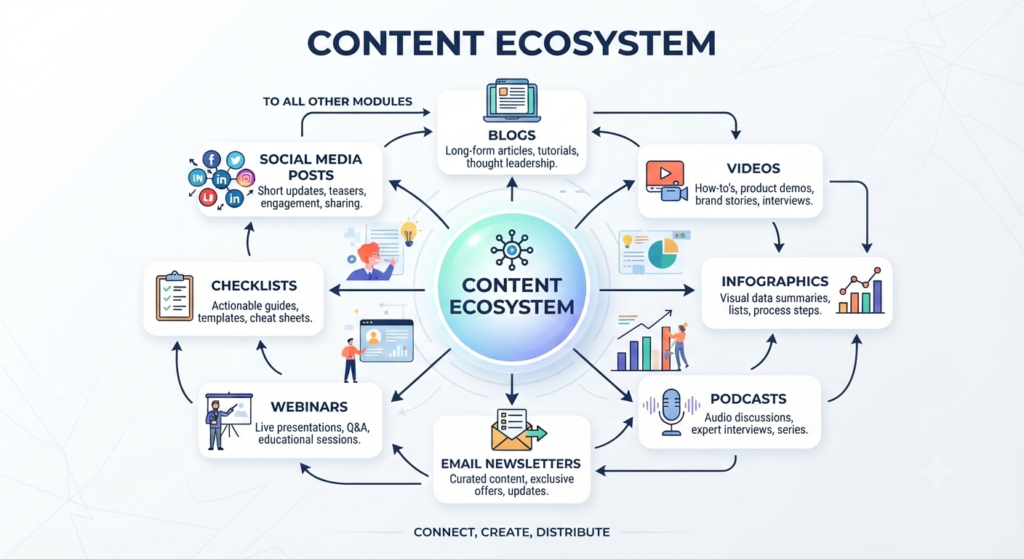
Content Marketing Strategy Framework
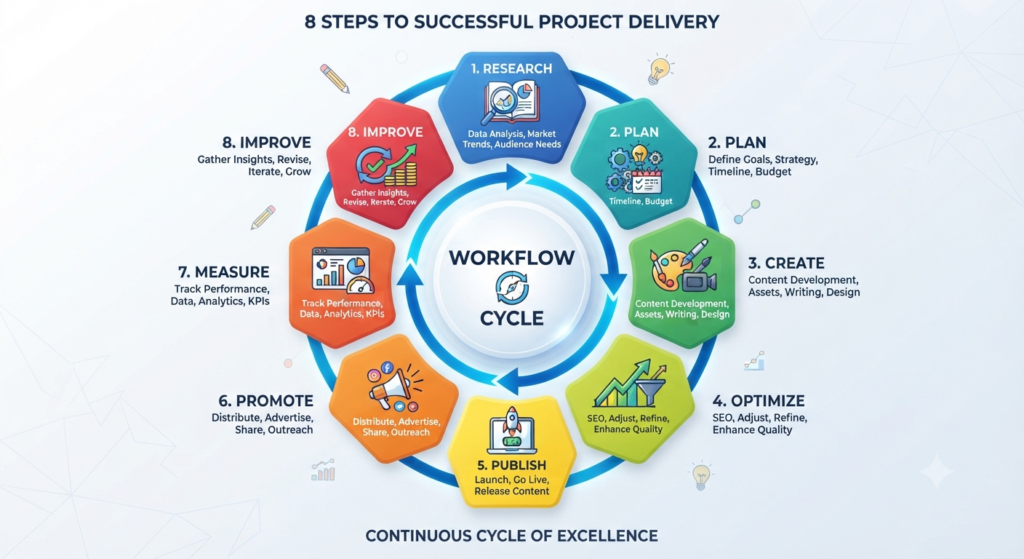
Use this simple framework to build a repeatable content process:
Research
Understand your audience, competitors, and search demand.
Plan
Define goals, keywords, and publishing schedules.
Create
Develop valuable, user-focused content.
Optimize
Apply SEO best practices without sacrificing readability.
Publish
Share content on your website.
Promote
Distribute through email, social media, and other relevant channels.
Measure
Track key performance indicators.
Improve
Refine content based on data and user feedback.
Following this framework keeps your Content Marketing Strategy consistent and scalable.
Content Marketing Strategy Comparison
| Without a Strategy | With a Strategy |
| Random content topics | Goal-driven content planning |
| Inconsistent publishing | Consistent publishing schedule |
| Weak SEO | Strong search optimization |
| Low traffic | Sustainable organic growth |
| Poor lead generation | Better-qualified leads |
| Limited authority | Strong topical authority |
| Difficult performance tracking | Clear measurement and optimization |
Implementation Roadmap
Week 1
- Define business goals
- Identify target audience
- Create buyer personas
Week 2
- Perform keyword research
- Build content pillars
- Create a content calendar
Week 3
- Write SEO-optimized content
- Design supporting visuals
- Optimize on-page SEO
Week 4
- Publish content
- Promote across channels
- Measure initial performance
Continue improving content every month based on analytics and audience feedback.
Common Mistakes to Avoid
Avoid these common mistakes when building your Content Marketing Strategy:
- Publishing without clear goals
- Ignoring search intent
- Targeting too many keywords in one article
- Writing only for search engines
- Neglecting audience research
- Inconsistent publishing
- Not updating old content
- Ignoring analytics
- Poor internal linking
- Failing to promote published content
Avoiding these mistakes can significantly improve long-term content performance.
Pro Tips
- Focus on solving one primary problem per article.
- Build topic clusters instead of isolated blog posts.
- Update high-performing content every 6–12 months.
- Repurpose successful content into multiple formats.
- Prioritize quality over publishing frequency.
- Create content that answers follow-up questions naturally.
- Use visuals to improve engagement and readability.
- Build internal links between related articles.
Content Marketing Strategy Checklist
Before publishing, confirm that you have:
✔ Defined a clear business goal
✔ Researched your target audience
✔ Identified the primary keyword
✔ Included supporting keywords naturally
✔ Matched search intent
✔ Created a compelling headline
✔ Optimized SEO elements
✔ Added internal and external links
✔ Included a strong call to action
✔ Reviewed grammar and readability
✔ Checked mobile responsiveness
✔ Planned content promotion
Frequently Asked Questions
What is a Content Marketing Strategy?
A Content Marketing Strategy is a structured plan for creating, publishing, promoting, and optimizing content that attracts, engages, and converts a target audience while supporting business goals.
Why is a Content Marketing Strategy important?
It provides direction, improves content quality, supports SEO, increases brand authority, and helps generate consistent traffic, leads, and conversions.
How often should I update my Content Marketing Strategy?
Review your strategy every quarter and update it whenever your business goals, audience needs, or industry trends change.
Is SEO part of a Content Marketing Strategy?
Yes. SEO helps your content become discoverable through search engines, making it a core component of an effective Content Marketing Strategy.
How long does content marketing take to show results?
Content marketing is a long-term investment. While some content may gain traction quickly, consistent publishing and optimization generally produce stronger results over time.
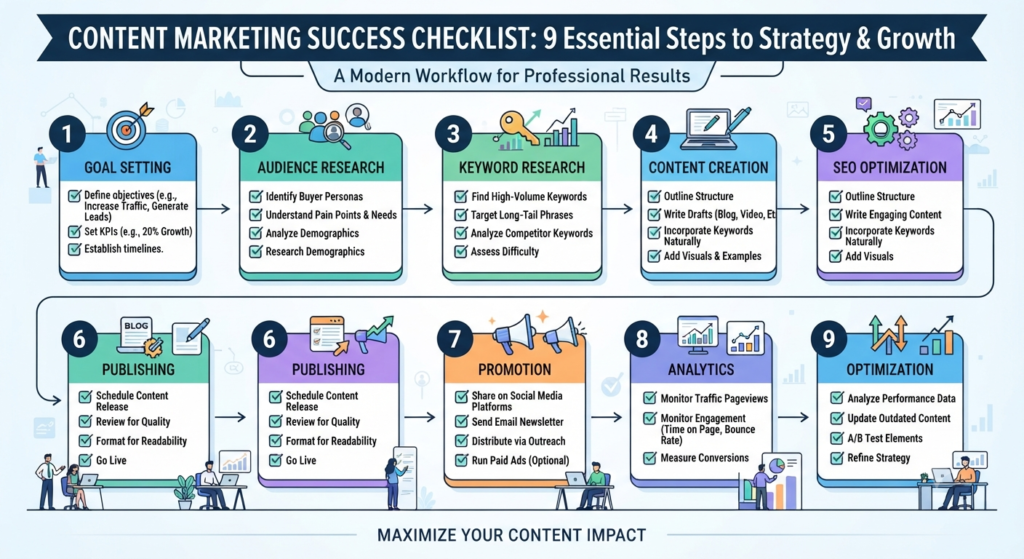
Conclusion
A well-planned Content Marketing Strategy is more than a publishing schedule—it’s a long-term roadmap for attracting the right audience, building trust, and achieving measurable business growth. By combining audience research, keyword planning, valuable content creation, SEO optimization, strategic distribution, and continuous performance analysis, you can create a system that delivers lasting results.
One of the biggest advantages of a strong Content Marketing Strategy is its ability to produce long-term value. Unlike paid advertising campaigns that stop generating traffic when the budget runs out, high-quality content can continue attracting visitors, generating leads, and building authority for months or even years. Every well-optimized blog post, video, infographic, or guide becomes a valuable digital asset that strengthens your online presence and supports future marketing efforts.
An effective Content Marketing Strategy also helps you build meaningful relationships with your audience. Modern consumers prefer brands that educate, solve problems, and provide helpful information before asking for a sale. By consistently publishing relevant and trustworthy content, you establish credibility and position your brand as a reliable source within your industry. This trust often translates into higher engagement, improved customer loyalty, and better conversion rates over time.
Remember that content marketing is not about producing the highest quantity of content. Instead, success comes from creating content that directly addresses user intent, answers important questions, and offers practical solutions. Before publishing any piece of content, ask yourself whether it genuinely helps your target audience. If the answer is yes, your Content Marketing Strategy is moving in the right direction.
It’s equally important to review your existing content regularly. Search trends, user expectations, and industry best practices evolve continuously. Updating older articles, improving internal linking, refreshing examples, and expanding valuable sections can often deliver better results than constantly creating new content. Continuous optimization ensures that your Content Marketing Strategy remains relevant and competitive in search results.
The most successful businesses treat their Content Marketing Strategy as an evolving process rather than a one-time project. Regularly update your content, monitor performance, adapt to changing audience needs, and focus on providing genuine value. Track key metrics such as organic traffic, engagement, conversions, and keyword rankings to understand what works and where improvements are needed. Use these insights to refine your strategy and make data-driven decisions instead of relying on assumptions.
With consistency, patience, and continuous improvement, your Content Marketing Strategy can become one of your strongest digital marketing assets for driving organic traffic, generating qualified leads, increasing brand authority, and supporting sustainable business growth. Start with a clear plan, remain committed to delivering value, and continuously refine your approach. Over time, a well-executed Content Marketing Strategy will not only help you achieve better search rankings but also build lasting relationships with your audience and create a competitive advantage that supports long-term success.