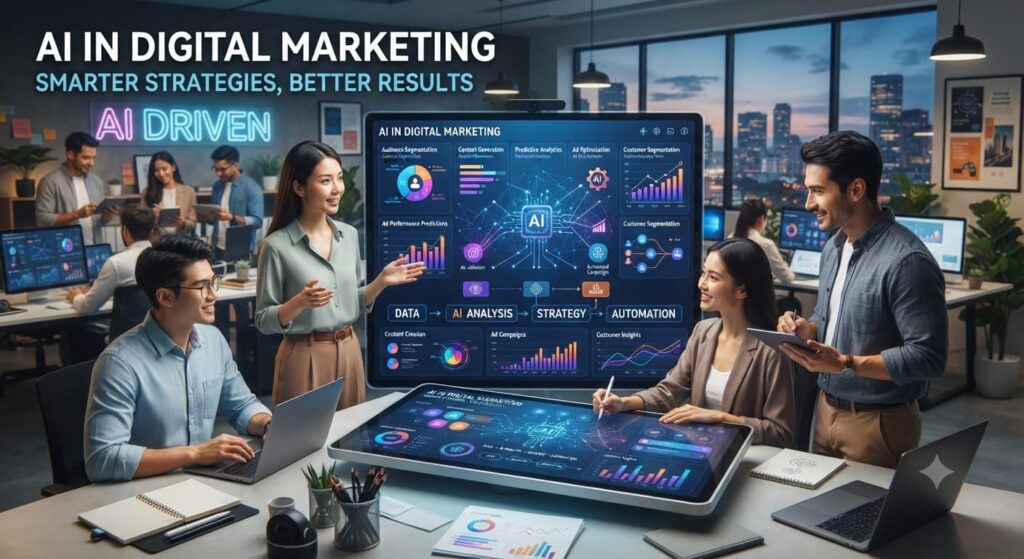

AI in Digital Marketing is transforming how businesses attract customers, personalize experiences, analyze data, and improve marketing performance. Artificial intelligence enables marketers to automate repetitive tasks, process massive amounts of customer data, predict user behavior, and make faster, data-driven decisions. From personalized email campaigns and AI-powered chatbots to predictive analytics and content recommendations, AI has become an essential part of modern digital marketing strategies.
As online competition continues to increase, businesses must deliver highly relevant and personalized experiences across multiple channels. Customers expect brands to understand their preferences, recommend products that match their interests, and provide instant support whenever needed. Meeting these expectations manually is increasingly difficult, especially for businesses managing thousands of customer interactions every day. AI helps solve this challenge by analyzing customer behavior in real time and automatically delivering personalized marketing experiences at scale.
Artificial intelligence is no longer limited to large enterprises with significant budgets. Today, businesses of all sizes can access AI-powered tools for content creation, advertising optimization, customer segmentation, social media management, search engine optimization, email marketing, and performance analytics. These solutions reduce manual effort while improving efficiency, allowing marketing teams to focus on strategy, creativity, and customer relationships instead of repetitive operational tasks.
However, successful implementation requires more than simply adopting AI tools. Businesses must understand where artificial intelligence adds value, which tasks should remain human-led, and how to combine automation with creativity and ethical decision-making. AI performs best when it supports marketers rather than replacing them. Human expertise remains essential for defining strategy, understanding customer emotions, maintaining brand identity, and making complex business decisions.
This comprehensive guide explains everything you need to know about AI in Digital Marketing, including its benefits, practical applications, implementation process, best practices, common challenges, and future trends. Whether you are a beginner exploring AI for the first time or an experienced marketer looking to improve campaign performance, this guide provides practical insights to help you use artificial intelligence effectively and responsibly.
Quick Answer
AI in Digital Marketing refers to the use of artificial intelligence technologies to automate marketing tasks, analyze customer data, personalize user experiences, optimize campaigns, and improve business decision-making. When combined with human creativity and strategic planning, AI helps businesses increase efficiency, improve customer engagement, and achieve better marketing results.
Why AI in Digital Marketing Matters
Modern customers interact with businesses through websites, search engines, social media, email, mobile applications, and online advertisements. Managing these interactions manually becomes increasingly challenging as customer expectations continue to grow.
Artificial intelligence enables businesses to process large volumes of information quickly, identify valuable insights, and respond to customer behavior more effectively.
An effective AI-powered marketing strategy helps businesses:
- Improve customer personalization
- Automate repetitive marketing tasks
- Analyze customer behavior faster
- Improve advertising performance
- Generate better-quality leads
- Increase customer engagement
- Enhance decision-making
- Support long-term business growth
Rather than replacing marketers, AI enhances their ability to create more effective and efficient marketing campaigns.
What Is AI in Digital Marketing?
AI in Digital Marketing is the application of artificial intelligence technologies to improve marketing activities through automation, machine learning, predictive analytics, natural language processing, and data analysis.
Common applications include:
- Content recommendations
- Email personalization
- Customer segmentation
- Chatbots
- Predictive analytics
- Advertisement optimization
- Lead scoring
- Product recommendations
- Voice search optimization
- Marketing analytics
These technologies help businesses deliver more relevant experiences while improving operational efficiency.
How AI in Digital Marketing Works
A typical AI-powered marketing process follows a structured workflow.
Customer Interaction
↓
Data Collection
↓
AI Analysis
↓
Pattern Recognition
↓
Customer Segmentation
↓
Personalized Recommendations
↓
Automated Marketing Actions
↓
Customer Engagement
↓
Performance Analysis
↓
Continuous Optimization
Understanding this workflow helps businesses identify where artificial intelligence can provide the greatest value.
Benefits of AI in Digital Marketing
Implementing AI in Digital Marketing provides numerous long-term advantages.
Improved Personalization
AI analyzes customer behavior to deliver personalized recommendations, content, and offers based on individual preferences.
Increased Marketing Efficiency
Automation reduces repetitive tasks, allowing marketing teams to focus on strategic planning and creative work.
Better Customer Insights
AI identifies patterns within customer data that may be difficult to recognize manually.
Faster Decision-Making
Real-time analytics help businesses respond quickly to changing customer behavior and market conditions.
Higher Campaign Performance
Artificial intelligence continuously analyzes campaign results and identifies opportunities for improvement.
Improved Customer Experience
Relevant recommendations, faster support, and personalized communication create stronger customer relationships.
AI in Digital Marketing vs Traditional Digital Marketing
| AI-Powered Marketing | Traditional Marketing |
|---|---|
| Automated decision support | Manual analysis |
| Real-time personalization | Generic messaging |
| Predictive insights | Historical reporting |
| Behavioral segmentation | Broad audience targeting |
| Continuous optimization | Periodic adjustments |
| Faster campaign management | Greater manual effort |
Many businesses achieve the best results by combining artificial intelligence with human expertise rather than relying entirely on automation.
Step 1: Define Clear Marketing Objectives
Successful AI implementation begins with measurable business goals.
Common objectives include:
- Increase website traffic
- Generate qualified leads
- Improve customer retention
- Increase online sales
- Improve conversion rates
- Enhance customer engagement
- Reduce marketing costs
- Improve campaign efficiency
Clear objectives help determine which AI solutions provide the greatest value.
Step 2: Collect High-Quality Customer Data
Artificial intelligence depends on accurate and relevant data.
Useful data sources include:
- Website analytics
- Customer purchases
- Search behavior
- Social media interactions
- Email engagement
- CRM systems
- Customer surveys
- Mobile applications
Well-organized data improves AI accuracy and marketing performance.
Step 3: Segment Your Audience Using AI
AI identifies meaningful customer groups based on behavior rather than simple demographic information.
Common segmentation factors include:
- Purchase history
- Browsing activity
- Product interests
- Customer lifetime value
- Geographic location
- Engagement frequency
- Device usage
- Shopping patterns
More accurate segmentation enables more personalized marketing campaigns.
Step 4: Automate Repetitive Marketing Tasks
One of the biggest advantages of AI is reducing manual work.
Tasks commonly automated include:
- Email campaigns
- Social media scheduling
- Customer support
- Lead qualification
- Advertisement bidding
- Performance reporting
- Product recommendations
- Workflow management
Automation increases consistency while improving overall marketing efficiency.
Step 5: Personalize Customer Experiences
Customers respond more positively to content that matches their interests and needs.
AI supports personalization through:
- Dynamic website content
- Product recommendations
- Personalized emails
- Customized advertisements
- Smart search results
- Individual offers
- Content suggestions
- Customer journey optimization
Personalization helps strengthen customer relationships while improving engagement and conversions.
Step 6: Optimize Advertising Campaigns
Artificial intelligence continuously evaluates advertising performance and recommends improvements.
AI can optimize:
- Audience targeting
- Bid strategies
- Budget allocation
- Ad placement
- Creative testing
- Conversion prediction
- Keyword selection
- Campaign scheduling
This data-driven approach helps marketers make more informed advertising decisions.
Step 7: Improve Customer Support with AI
AI-powered customer support tools provide faster responses while reducing operational workload.
Common applications include:
- Chatbots
- Virtual assistants
- Automated FAQs
- Customer routing
- Appointment scheduling
- Product recommendations
- Order tracking
- Basic troubleshooting
These solutions improve customer satisfaction while allowing human support teams to focus on more complex inquiries.
Step 8: Use Predictive Analytics for Smarter Decisions
Predictive analytics enables businesses to anticipate customer behavior by analyzing historical and real-time data. Instead of reacting after an event occurs, marketers can make proactive decisions that improve campaign performance.
Predictive analytics can help with:
- Purchase forecasting
- Customer lifetime value estimation
- Churn prediction
- Demand forecasting
- Lead scoring
- Product recommendations
- Sales forecasting
- Customer retention planning
Using predictive insights helps businesses allocate marketing resources more efficiently.
Step 9: Improve SEO with Artificial Intelligence
Search engine optimization requires continuous analysis, content improvements, and keyword research. AI-powered tools simplify many of these tasks while providing valuable recommendations.
AI can assist with:
- Keyword research
- Search intent analysis
- Content optimization
- Internal linking suggestions
- Technical SEO audits
- Competitor analysis
- Topic clustering
- Content gap identification
Although AI speeds up research and optimization, human expertise is still essential for producing original, trustworthy, and audience-focused content.
Step 10: Create Better Content with AI Assistance
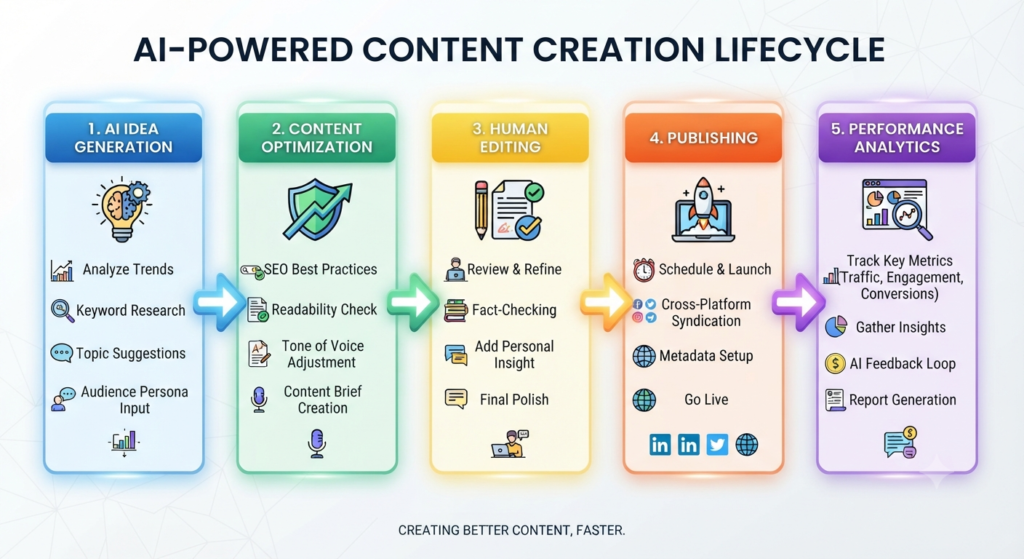
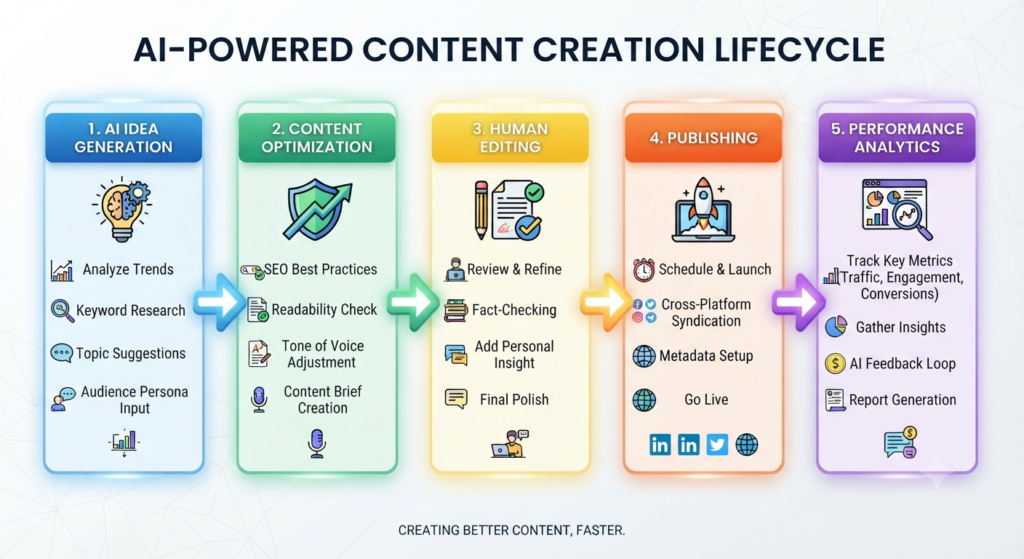
Content remains one of the most valuable digital marketing assets. AI helps marketers generate ideas, organize information, and improve efficiency throughout the content creation process.
AI can support:
- Topic brainstorming
- Content outlines
- Headline generation
- Grammar improvements
- Content summaries
- Email drafts
- Social media captions
- Content optimization
Businesses should always review AI-generated content for accuracy, originality, and brand consistency before publishing.
Step 11: Strengthen Email Marketing
Artificial intelligence improves email marketing by delivering personalized communication based on subscriber behavior.
AI can optimize:
- Subject lines
- Send times
- Audience segmentation
- Product recommendations
- Workflow automation
- Content personalization
- Engagement prediction
- Customer retention campaigns
More relevant emails generally produce stronger engagement and better long-term customer relationships.
Step 12: Enhance Social Media Marketing
Managing multiple social media platforms manually can be time-consuming. AI helps simplify planning, publishing, and performance analysis.
AI-powered social media tasks include:
- Content scheduling
- Caption suggestions
- Trend monitoring
- Audience analysis
- Sentiment analysis
- Performance reporting
- Hashtag recommendations
- Best posting time predictions
Automation improves efficiency while allowing marketers to focus on community engagement and creative storytelling.
Step 13: Measure Marketing Performance
Effective AI in Digital Marketing depends on continuous performance monitoring and optimization.
Important metrics include:
| Metric | Why It Matters |
|---|---|
| Website Traffic | Measures audience growth |
| Conversion Rate | Tracks marketing effectiveness |
| Customer Acquisition Cost | Evaluates marketing efficiency |
| Return on Investment | Measures business impact |
| Click-Through Rate | Indicates engagement |
| Bounce Rate | Reflects user experience |
| Customer Retention | Measures loyalty |
| Revenue Growth | Evaluates long-term success |
Reviewing these metrics regularly helps businesses identify strengths, weaknesses, and opportunities for improvement.
Step 14: Address Ethical and Privacy Considerations
Artificial intelligence should always be implemented responsibly. Businesses must balance automation with transparency and customer trust.
Important considerations include:
- Protect customer data
- Follow privacy regulations
- Explain AI-powered recommendations when appropriate
- Avoid misleading automation
- Review automated decisions regularly
- Maintain human oversight
- Prevent algorithm bias
- Respect customer preferences
Responsible AI implementation strengthens long-term customer confidence.
Step 15: Continuously Optimize AI Strategies
Artificial intelligence performs best when it learns from updated information and changing customer behavior.
Regular optimization includes:
- Updating customer data
- Testing new automation workflows
- Improving AI prompts
- Monitoring campaign performance
- Reviewing content quality
- Refining audience segments
- Evaluating marketing objectives
- Adopting new AI capabilities when appropriate
Continuous improvement ensures AI remains aligned with evolving business goals.
AI Implementation Framework
A structured implementation process reduces complexity and improves long-term success.
Plan
Identify marketing objectives and priority use cases.
Prepare
Collect high-quality customer data and select suitable AI tools.
Implement
Launch AI-powered workflows gradually across marketing channels.
Measure
Track key performance indicators and customer engagement.
Optimize
Use performance insights to improve campaigns and automation continuously.
Following this framework helps businesses implement AI in Digital Marketing systematically rather than adopting technology without a clear strategy.
AI Applications Across Marketing Channels
| Marketing Area | AI Application | Primary Benefit |
|---|---|---|
| SEO | Keyword research and optimization | Better search visibility |
| Email Marketing | Personalized campaigns | Higher engagement |
| Social Media | Content scheduling | Improved efficiency |
| Paid Advertising | Smart bidding | Better ROI |
| Customer Support | Chatbots | Faster responses |
| Content Marketing | Content assistance | Increased productivity |
| Analytics | Predictive insights | Better decision-making |
| CRM | Customer segmentation | Stronger personalization |
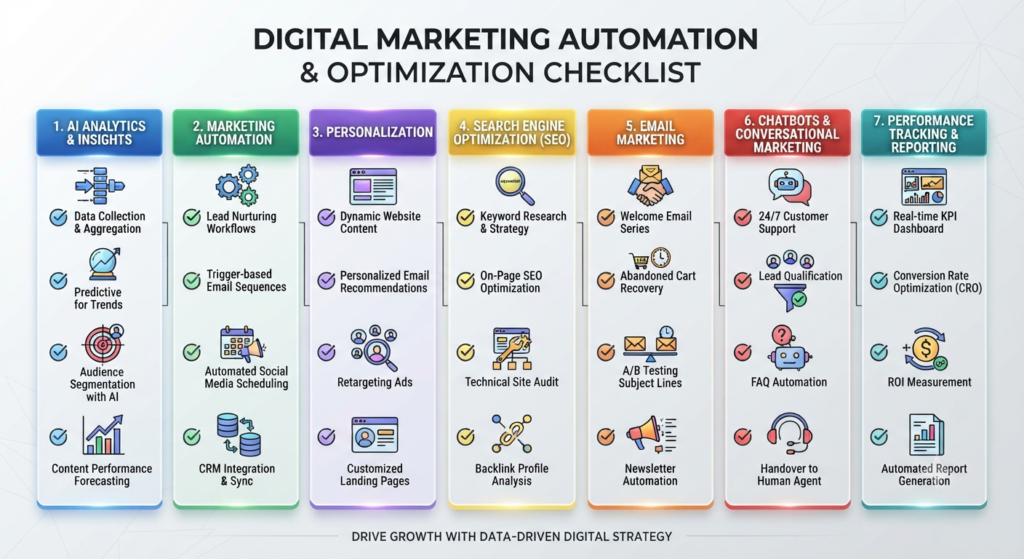
Combining multiple AI applications creates a more connected and efficient digital marketing ecosystem.
30-Day AI Marketing Action Plan
Week 1
- Define marketing objectives
- Audit existing marketing processes
- Identify repetitive tasks
- Select appropriate AI tools
Week 2
- Organize customer data
- Implement AI-powered analytics
- Improve audience segmentation
- Create AI-assisted content workflows
Week 3
- Optimize email campaigns
- Improve advertising strategies
- Launch chatbot support
- Monitor campaign performance
Week 4
- Analyze marketing results
- Refine AI workflows
- Improve personalization
- Plan future AI initiatives
A structured roadmap helps businesses adopt artificial intelligence gradually while minimizing implementation challenges.
Common Mistakes to Avoid
Avoid these mistakes when implementing AI in Digital Marketing:
- Depending entirely on automation
- Ignoring data quality
- Publishing AI-generated content without review
- Overlooking customer privacy
- Using too many AI tools simultaneously
- Failing to measure performance
- Ignoring human creativity
- Setting unrealistic expectations
- Neglecting continuous optimization
- Forgetting brand consistency
Avoiding these issues helps businesses maximize the value of artificial intelligence while maintaining customer trust.
Pro Tips
- Use AI to support decision-making rather than replace human judgment.
- Begin with one marketing channel before expanding automation.
- Regularly review AI-generated content for quality and accuracy.
- Keep customer data organized and updated.
- Test AI recommendations before applying them widely.
- Monitor performance using measurable business outcomes.
- Balance automation with genuine human interaction.
- Continue learning as AI technologies evolve.
AI in Digital Marketing Checklist
Before scaling your AI strategy, confirm the following:
✔ Clear marketing objectives are defined
✔ Reliable customer data is available
✔ AI tools align with business needs
✔ Audience segmentation is implemented
✔ Automation workflows are tested
✔ Performance tracking is enabled
✔ Privacy standards are followed
✔ Human review remains part of the process
✔ Marketing results are analyzed regularly
✔ Optimization plan is established
✔ Team members understand AI workflows
✔ Customer experience remains the top priority
Frequently Asked Questions
What is AI in Digital Marketing?
AI in Digital Marketing is the use of artificial intelligence technologies to automate marketing activities, analyze customer behavior, personalize communication, and improve campaign performance.
How does AI improve digital marketing?
AI improves efficiency by automating repetitive tasks, analyzing large datasets, predicting customer behavior, and delivering personalized marketing experiences.
Can small businesses use AI for marketing?
Yes. Many affordable AI-powered tools help small businesses improve content creation, email marketing, customer support, analytics, and advertising without requiring large teams.
Does AI replace digital marketers?
No. AI supports marketers by automating repetitive work and providing insights, while humans remain responsible for strategy, creativity, ethics, and relationship building.
What are the biggest benefits of AI in marketing?
The major benefits include improved personalization, faster decision-making, increased efficiency, better customer insights, stronger campaign performance, and scalable marketing operations.
Conclusion
A well-planned AI in Digital Marketing strategy enables businesses to automate repetitive tasks, deliver personalized customer experiences, analyze data more effectively, and make smarter marketing decisions. Rather than replacing human expertise, artificial intelligence serves as a powerful assistant that improves efficiency while allowing marketers to focus on creativity, strategy, and meaningful customer relationships. Businesses that combine AI capabilities with strong marketing fundamentals are better positioned to improve engagement, generate qualified leads, and achieve sustainable business growth.
Successful implementation begins with clear objectives, reliable customer data, and carefully selected AI tools that align with specific business needs. Organizations should introduce automation gradually, monitor performance consistently, and refine workflows based on measurable outcomes instead of relying solely on technology. Continuous testing, audience analysis, and campaign optimization help ensure that AI continues delivering value as customer expectations and market conditions evolve.
It is equally important to recognize the limitations of artificial intelligence. While AI excels at processing data, identifying patterns, and automating repetitive tasks, it cannot fully replace human creativity, emotional intelligence, ethical judgment, or strategic thinking. Businesses that maintain this balance are more likely to build authentic customer relationships and protect long-term brand trust.
As artificial intelligence continues advancing, marketers who embrace continuous learning and responsible implementation will gain a significant competitive advantage. By applying AI in Digital Marketing thoughtfully, focusing on customer value, and using data to support informed decisions, businesses can improve operational efficiency, strengthen customer engagement, increase marketing performance, and create a scalable digital marketing strategy capable of supporting long-term success.
The future of marketing will increasingly combine artificial intelligence with human expertise rather than treating them as competing approaches. Businesses that invest in continuous learning, regularly evaluate new AI capabilities, and adapt their strategies based on customer behavior will be better prepared for changing market conditions. At the same time, maintaining transparency, protecting customer data, and preserving authentic brand communication should remain top priorities.
Artificial intelligence can process information and identify patterns quickly, but long-term customer loyalty is still built through trust, creativity, empathy, and meaningful relationships. Organizations should view AI as a strategic partner that supports smarter decision-making instead of a complete replacement for human marketers.
By maintaining this balance and refining workflows based on measurable performance, businesses can unlock greater efficiency while continuing to deliver valuable customer experiences. With a thoughtful implementation strategy and a commitment to continuous improvement, AI in Digital Marketing can become a sustainable competitive advantage that supports innovation, stronger customer engagement, improved operational efficiency, and long-term business success in an increasingly digital world.