

E-commerce Conversion Rate is one of the most important metrics for measuring the success of an online store. While increasing website traffic is valuable, traffic alone does not guarantee sales. The real indicator of business growth is how many visitors complete a desired action, such as making a purchase, signing up for a newsletter, or adding products to a cart. This is where understanding and improving your E-commerce Conversion Rate becomes essential.
Many online businesses invest heavily in SEO, paid advertising, email marketing, and social media campaigns to attract visitors. However, if the website fails to convert those visitors into customers, much of that marketing investment goes to waste. Improving your E-commerce Conversion Rate helps maximize the value of your existing traffic, often producing better returns than simply spending more on customer acquisition.
Whether you run a small online store, a growing e-commerce brand, or a large marketplace, optimizing your E-commerce Conversion Rate can lead to higher revenue, better customer experience, improved profitability, and sustainable business growth. This guide explains the key factors that influence conversions, practical optimization techniques, common mistakes to avoid, and proven strategies that help turn more visitors into paying customers.
By the end of this guide, you’ll understand how to evaluate your current E-commerce Conversion Rate, identify conversion barriers, and implement improvements that create a smoother shopping experience while supporting long-term business success.
Quick Answer
An E-commerce Conversion Rate is the percentage of website visitors who complete a desired action, such as purchasing a product. It is calculated by dividing the number of conversions by the total number of visitors and multiplying the result by 100. Improving this metric helps online businesses generate more sales without necessarily increasing website traffic.
Why E-commerce Conversion Rate Matters
Driving traffic to an online store requires time, effort, and marketing investment. If only a small percentage of visitors convert into customers, overall profitability may suffer.
A strong E-commerce Conversion Rate helps businesses:
- Increase revenue from existing traffic
- Improve return on advertising investment
- Reduce customer acquisition costs
- Enhance user experience
- Strengthen customer trust
- Increase repeat purchases
- Support long-term business growth
Rather than focusing only on attracting more visitors, businesses that optimize conversions make better use of the traffic they already receive.
What Is an E-commerce Conversion Rate?
An E-commerce Conversion Rate measures the percentage of visitors who complete a predefined goal on an online store.
The most common conversion is a completed purchase, but other valuable actions may include:
- Creating an account
- Subscribing to a newsletter
- Adding a product to the cart
- Downloading a buying guide
- Starting a live chat
- Requesting product information
Although purchases are usually the primary objective, tracking multiple conversion actions provides a more complete picture of customer behavior.
How to Calculate E-commerce Conversion Rate
The formula is straightforward:
E-commerce Conversion Rate = (Number of Conversions ÷ Total Website Visitors) × 100
Example
Suppose an online store receives:
- Website Visitors: 12,000
- Completed Orders: 360
Calculation:
(360 ÷ 12,000) × 100 = 3%
This means the store’s E-commerce Conversion Rate is 3%, indicating that three out of every one hundred visitors completed a purchase.
What Is Considered a Good E-commerce Conversion Rate?
There is no universal benchmark because conversion rates vary depending on industry, product category, pricing, traffic sources, and customer intent.
Generally, businesses should compare performance against:
- Historical store performance
- Similar product categories
- Marketing channel performance
- Device-specific conversion rates
- Seasonal trends
Instead of chasing industry averages, focus on consistently improving your own E-commerce Conversion Rate through testing and optimization.
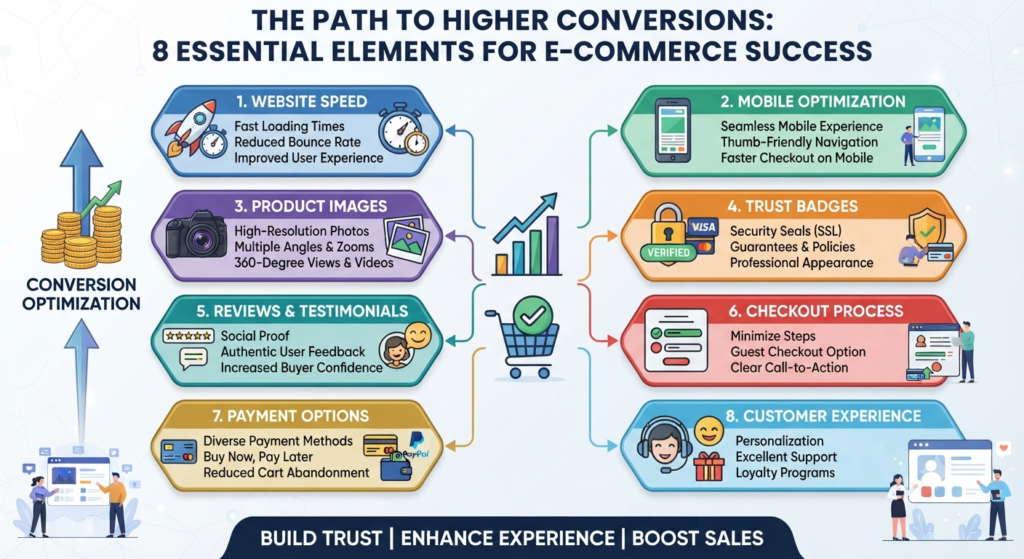
Factors That Influence E-commerce Conversion Rate
Several elements affect whether visitors decide to complete a purchase.
| Factor | Impact on Conversions |
|---|---|
| Website Speed | Faster pages reduce abandonment |
| Mobile Experience | Improves shopping convenience |
| Product Images | Increase buyer confidence |
| Product Descriptions | Help customers make informed decisions |
| Pricing Transparency | Reduces hesitation |
| Customer Reviews | Build trust |
| Checkout Process | Reduces cart abandonment |
| Payment Options | Improves purchasing flexibility |
| Shipping Information | Eliminates uncertainty |
| Website Trust Signals | Increase credibility |
Improving multiple factors together often has a greater impact than focusing on a single area.
Benefits of Improving E-commerce Conversion Rate
A higher E-commerce Conversion Rate creates advantages across every stage of the customer journey.
Increase Revenue Without More Traffic
Improving conversions allows businesses to generate more sales from existing visitors, making marketing investments more efficient.
Better Return on Marketing Investment
Whether traffic comes from SEO, paid advertising, or email campaigns, a stronger conversion rate increases the return on every marketing dollar spent.
Lower Customer Acquisition Costs
When more visitors become customers, the cost of acquiring each customer decreases.
Better Customer Experience
Optimization efforts often improve website navigation, checkout processes, and product information, creating a smoother shopping journey.
Stronger Customer Trust
Transparent pricing, secure payments, customer reviews, and clear policies help visitors feel confident purchasing from your store.
Common Reasons Visitors Don’t Convert
Understanding why customers leave without buying is essential for improving your E-commerce Conversion Rate.
Common reasons include:
- Slow-loading pages
- Complicated navigation
- Poor mobile optimization
- Hidden shipping costs
- Long checkout process
- Limited payment methods
- Weak product descriptions
- Low-quality product images
- Lack of customer reviews
- Security concerns
Identifying these issues through analytics and customer feedback helps prioritize improvements.
Step 1: Understand Your Customers
Every successful E-commerce Conversion Rate optimization strategy begins with understanding customer behavior.
Research:
- Customer demographics
- Shopping habits
- Purchase motivations
- Common objections
- Device preferences
- Traffic sources
- Frequently asked questions
The better you understand your audience, the easier it becomes to create an experience that encourages conversions.
Step 2: Improve Website Speed
Website speed directly affects user experience and purchase decisions.
To improve loading performance:
- Compress images
- Enable browser caching
- Minimize unnecessary scripts
- Use a reliable hosting provider
- Optimize CSS and JavaScript
- Reduce page redirects
Even small improvements in page speed can contribute to a better E-commerce Conversion Rate, particularly on mobile devices.
Step 3: Optimize for Mobile Users
A significant share of online shopping now takes place on smartphones and tablets.
Ensure your website provides:
- Responsive design
- Fast mobile loading
- Large tap targets
- Simple navigation
- Mobile-friendly checkout
- Readable fonts
- Optimized product images
A seamless mobile experience removes friction and encourages customers to complete their purchases.
Step 4: Create High-Quality Product Pages
Product pages often determine whether visitors become customers.
Every product page should include:
- High-resolution images
- Multiple viewing angles
- Clear product descriptions
- Key features
- Benefits
- Product specifications
- Pricing
- Availability
- Shipping information
- Return policy
Well-structured product pages help shoppers make confident purchasing decisions while improving your E-commerce Conversion Rate.
Step 5: Write Persuasive Product Descriptions
Instead of listing only product specifications, explain how the product solves customer problems.
A strong product description should include:
- Benefits before features
- Clear language
- Customer-focused messaging
- Frequently asked questions
- Care instructions where applicable
- Size or compatibility information
Focus on answering the questions shoppers commonly ask before making a purchase.
Step 6: Use High-Quality Product Images
Visual content strongly influences buying decisions.
Best practices include:
- Multiple product angles
- Zoom functionality
- Lifestyle images
- White background images
- Product demonstration photos
- Consistent image quality
Professional product photography helps customers understand what they are purchasing and reduces uncertainty.
Step 7: Build Customer Trust
Trust plays a major role in improving your E-commerce Conversion Rate.
Ways to build trust include:
- Display verified customer reviews
- Show secure payment badges
- Provide transparent return policies
- Include contact information
- Offer responsive customer support
- Display shipping timelines
- Use HTTPS across your website
- Clearly communicate privacy practices
When customers feel confident about your business, they are more likely to complete their purchases.
Step 8: Simplify the Checkout Process
A complicated checkout process is one of the biggest reasons customers abandon their carts. Even if shoppers are interested in your products, unnecessary steps or confusing forms can reduce your E-commerce Conversion Rate.
A streamlined checkout should:
- Minimize the number of steps
- Request only essential information
- Offer guest checkout
- Display progress indicators
- Auto-fill addresses where possible
- Show order summaries clearly
- Allow customers to edit their cart easily
Reducing friction during checkout makes it easier for customers to complete their purchases.
Step 9: Reduce Cart Abandonment
Cart abandonment is common in e-commerce, but many abandoned carts can be recovered with the right strategy.
Ways to reduce abandonment include:
- Be transparent about shipping costs
- Offer multiple payment options
- Send abandoned cart reminder emails
- Display trust badges
- Simplify the checkout experience
- Provide live chat support
- Save shopping carts for returning visitors
- Avoid forcing account creation
Addressing these issues can significantly improve your E-commerce Conversion Rate while enhancing the overall customer experience.
Step 10: Offer Multiple Payment Options
Customers prefer different payment methods depending on their location and preferences. Limiting payment choices may result in lost sales.
Consider supporting:
- Credit cards
- Debit cards
- Digital wallets
- Buy Now, Pay Later (where appropriate)
- Net banking
- UPI (for supported regions)
- Bank transfers
Providing secure and convenient payment options increases customer confidence and removes barriers to purchase.
Step 11: Use Customer Reviews and Social Proof
People often look for reassurance before making a purchase. Reviews and testimonials help reduce uncertainty and build trust.
Effective social proof includes:
- Verified customer reviews
- Product ratings
- Customer photos
- Frequently purchased products
- Best-seller labels
- Recently purchased notifications (used responsibly)
- User-generated content
Authentic customer feedback helps visitors make informed purchasing decisions and supports a stronger E-commerce Conversion Rate.
Step 12: Optimize Calls to Action (CTAs)
A clear call to action guides visitors toward the next step in the buying journey.
Examples include:
- Add to Cart
- Buy Now
- Shop Collection
- View Details
- Start Checkout
- Get Yours Today
Make CTA buttons easy to notice by using consistent styling, clear wording, and placing them near important product information.
Step 13: Use A/B Testing
A/B testing compares two versions of a page or element to determine which performs better.
Common elements to test include:
- Headlines
- Product images
- CTA button text
- CTA button placement
- Product descriptions
- Pricing presentation
- Checkout layouts
- Promotional banners
Test one variable at a time so you can accurately measure its impact on your E-commerce Conversion Rate.
Step 14: Measure Performance with Analytics
Data-driven decisions are essential for long-term improvement.
Monitor metrics such as:
| Metric | Why It Matters |
|---|---|
| Conversion Rate | Overall purchasing performance |
| Cart Abandonment Rate | Checkout effectiveness |
| Average Order Value | Revenue per purchase |
| Revenue per Visitor | Website profitability |
| Bounce Rate | Landing page relevance |
| Session Duration | Visitor engagement |
| Returning Customers | Customer loyalty |
| Checkout Completion Rate | Purchase efficiency |
Regular analysis helps identify opportunities for optimization.
Step 15: Continuously Improve Your Store
Conversion optimization is an ongoing process rather than a one-time project.
Review your online store regularly by:
- Updating product pages
- Refreshing images
- Improving navigation
- Monitoring customer feedback
- Testing new layouts
- Reviewing analytics
- Updating FAQs
- Optimizing mobile usability
Small, consistent improvements often produce significant long-term gains.
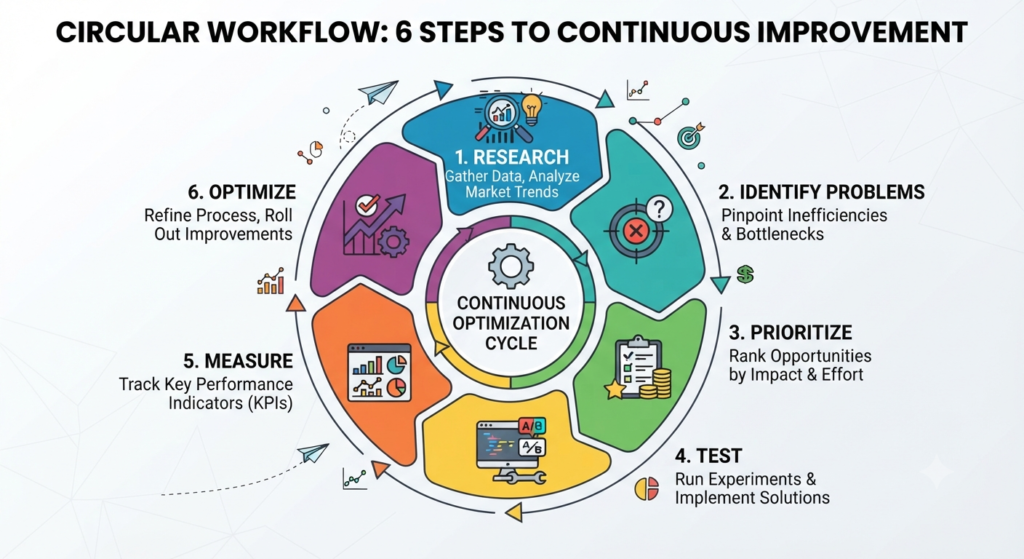
E-commerce Conversion Rate Optimization Framework
Follow this repeatable workflow:
Research
Study customer behavior using analytics, heatmaps, and customer feedback.
Identify Problems
Locate pages with high exit rates, abandoned carts, or low engagement.
Prioritize Improvements
Focus on changes that are likely to have the greatest business impact.
Test Solutions
Use A/B testing to validate improvements before implementing them widely.
Measure Results
Track performance metrics after every change.
Optimize Again
Continue refining the shopping experience based on new insights.
This continuous cycle helps businesses steadily improve their E-commerce Conversion Rate over time.
E-commerce Conversion Rate Comparison
| Poorly Optimized Store | Well-Optimized Store |
|---|---|
| Slow loading pages | Fast website performance |
| Complicated checkout | Simple checkout flow |
| Limited payment methods | Multiple secure payment options |
| Weak product images | High-quality product visuals |
| Minimal trust signals | Strong reviews and security badges |
| Poor mobile experience | Responsive mobile design |
| Confusing navigation | Clear user-friendly navigation |
| Low customer confidence | High purchasing confidence |
30-Day E-commerce Conversion Rate Improvement Plan
Week 1
- Analyze website analytics
- Identify conversion bottlenecks
- Review customer feedback
Week 2
- Improve product pages
- Optimize website speed
- Enhance mobile experience
Week 3
- Simplify checkout
- Add trust signals
- Improve calls to action
Week 4
- Launch A/B tests
- Measure results
- Document improvements
- Plan future optimization
Following a structured roadmap helps businesses improve conversions systematically rather than making random changes.
Common Mistakes to Avoid
Avoid these mistakes when improving your E-commerce Conversion Rate:
- Ignoring mobile users
- Using low-quality product images
- Hiding shipping costs
- Creating lengthy checkout forms
- Offering limited payment methods
- Ignoring customer reviews
- Not testing website changes
- Focusing only on traffic instead of conversions
- Neglecting website speed
- Failing to monitor analytics
Correcting these issues can have a measurable impact on conversion performance.
Pro Tips
- Optimize your highest-traffic pages first.
- Use customer feedback to identify friction points.
- Keep product descriptions clear and benefit-focused.
- Regularly test headlines and CTA buttons.
- Display shipping information before checkout.
- Make your return policy easy to find.
- Monitor performance separately for desktop and mobile users.
- Review analytics every month to identify new opportunities.
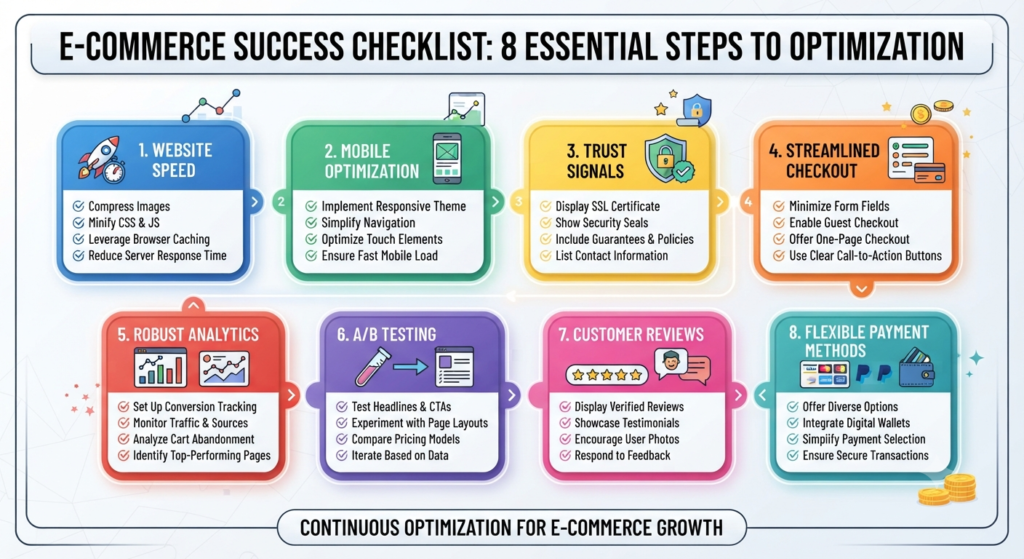
E-commerce Conversion Rate Checklist
Before launching optimization changes, confirm that you have:
✔ Fast-loading website
✔ Mobile-responsive design
✔ High-quality product images
✔ Clear product descriptions
✔ Transparent pricing
✔ Visible customer reviews
✔ Multiple payment methods
✔ Simple checkout process
✔ Strong security signals
✔ Analytics tracking enabled
✔ A/B testing plan in place
✔ Customer support information available
Frequently Asked Questions
What is an E-commerce Conversion Rate?
An E-commerce Conversion Rate is the percentage of website visitors who complete a desired action, most commonly making a purchase. It helps measure how effectively an online store converts traffic into customers.
How do you calculate an E-commerce Conversion Rate?
Divide the number of conversions by the total number of website visitors and multiply the result by 100.
Why is my E-commerce Conversion Rate low?
Common reasons include slow website speed, poor mobile experience, confusing navigation, complicated checkout, weak product pages, hidden costs, or lack of customer trust.
How can I improve my E-commerce Conversion Rate?
Focus on improving website speed, optimizing product pages, simplifying checkout, building trust, offering multiple payment options, and continuously testing improvements using analytics.
Is increasing traffic always the best way to grow sales?
Not necessarily. Improving your E-commerce Conversion Rate often generates more revenue from existing visitors, making your marketing efforts more cost-effective.
Conclusion
A high E-commerce Conversion Rate is not achieved through a single website change but through continuous improvements across the entire customer journey. Every interaction—from the first landing page visit to the final checkout confirmation—plays a role in influencing purchasing decisions. By optimizing website speed, improving product pages, simplifying navigation, building customer trust, and reducing checkout friction, businesses create a shopping experience that encourages more visitors to become customers.
One of the greatest advantages of focusing on E-commerce Conversion Rate optimization is that it helps maximize the value of your existing traffic. Instead of relying solely on larger advertising budgets or higher search rankings, businesses can increase revenue by making it easier for visitors to complete their purchases. This approach often delivers sustainable growth while improving customer satisfaction and overall profitability.
Remember that conversion optimization is an ongoing process. Customer expectations, technology, and market trends continue to evolve, making regular analysis and testing essential. Review analytics, gather customer feedback, conduct A/B tests, and update your store based on real user behavior rather than assumptions. Small improvements made consistently can produce meaningful long-term results.
Businesses that treat E-commerce Conversion Rate optimization as a continuous strategy rather than a one-time task are better positioned to improve customer experience, increase sales, strengthen brand loyalty, and achieve sustainable business growth. By combining data-driven decision-making with customer-focused design, you can build an online store that not only attracts visitors but also converts them into loyal, repeat customers.